La Masseria Delle Allodole

La Masseria Delle Allodole

Movie · 2007 · 3 people

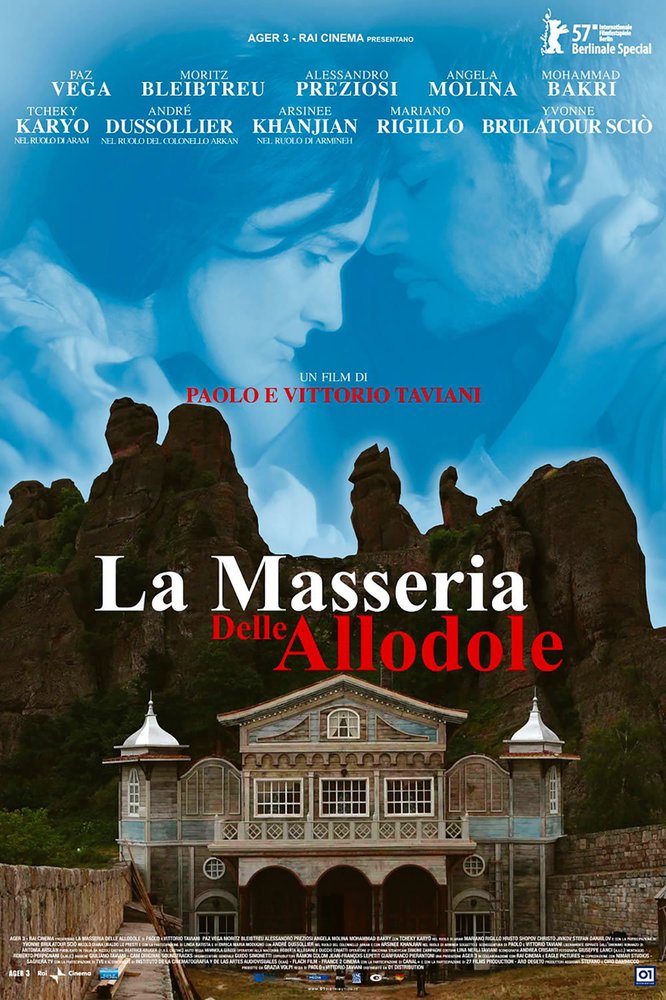
Brothers Paolo and Vittorio Taviani wrote and directed the 2007 historical drama La Masseria Delle Allodole (The Lark Farm). Shot in Italian, it is a co-production of Italy, France, Germany, Spain and Bulgaria, and counts as the Tavianis' eighteenth film. It is regarded as one of the rare screen treatments of the Armenian genocide. The title has also travelled as Le Mas des alouettes in French, Das Haus der Lerchen in German and El destino de Nunik in Spanish.

The screenplay draws on the historical novel of the same name by the Italian writer and literary scholar Antonia Arslan. The story follows an Armenian family in Anatolia in 1915, during the First World War, as the genocide that destroyed some 1.5 million Armenians under Ottoman rule closes in on them. The leads are Paz Vega, Moritz Bleibtreu, Alessandro Preziosi, Ángela Molina and Tchéky Karyo, with André Dussollier, Arsinée Khanjian, Hristo Shopov, Mohammad Bakri, Itzhak Fintzi and Laura Efrikian also in the cast.

Giuseppe Lanci was the cinematographer and Giuliano Taviani composed the music. The film runs 122 minutes.

DirectorPaolo Taviani, Vittorio Taviani

Reactions

You can pick up to 3 reactions.

Cast

Only cast members with a profile on this site are listed.

Through different eyes

History & Society Lens Asks about the period, the social background and what the work reflects.

The film follows what befalls an Armenian family in Anatolia in 1915, during the First World War, and is regarded as one of cinema's rare treatments of the Armenian genocide. Its basis in Antonia Arslan's historical novel explains the effort to make a vast tragedy visible at the scale of a single family. Focusing on one household is a strong choice for reminding us of the people behind the numbers. On the other hand, being shot in Italian as a co-production of five European countries raises the question of how far it can capture Anatolia's language and everyday texture. A heavy but important film for anyone willing to think about facing history.

Cinephile Looks at script, editing and directing choices; keeps a distance from formula films.

The Taviani brothers' eighteenth feature sets a great historical wound inside the frame of a family drama. Giuseppe Lanci's cinematography and Giuliano Taviani's score give it a classical, almost operatic tone. A cast that brings together actors from different countries, such as Paz Vega, Moritz Bleibtreu and Ángela Molina, shows what an international co-production can assemble, but having everyone perform in Italian sometimes undercuts the characters' authenticity. There are also moments that lean on melodrama, underlining emotion too heavily in the face of such a grave subject. Even so, over 122 minutes the narrative never loses its way, and it approaches a history cinema has rarely touched with real seriousness.

Family Viewer Asks whether the whole household can watch it; cares about humour and heart.

This is not a film to put on casually with the family. It tells what happens to one family during a genocide, and the subject is very heavy. It is not suitable for young children. With high-school-age teenagers it can be watched together if you are ready to talk about history, and do leave time to talk afterwards. It also runs 122 minutes, so plan for that.

These are not reader reviews: they are short editorial takes written from different viewer perspectives with AI assistance. Reader reviews are below.

Reviews (0)

Log in Log in to write a review.

Comments