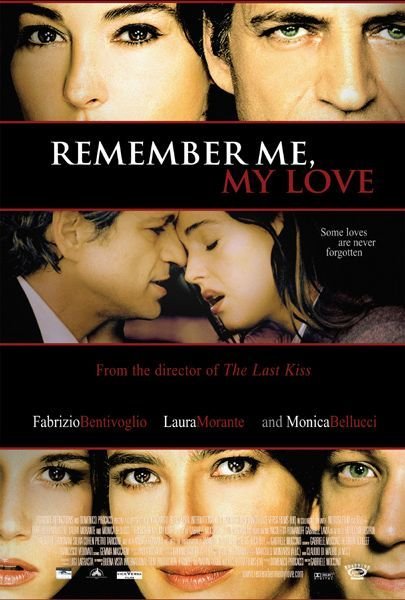
Remember Me, My Love

Remember Me, My Love (Ricordati di me)

Movie · 2003 · 15 people

Released in Turkey as Beni Unutma, the Italian film Remember Me, My Love (Italian original Ricordati di me) was made in 2003. Described as a comedy-drama and a romance, it deals with the emotional troubles of a middle-class family of four. A co-production between Italy, France and the United Kingdom, it runs about 117 minutes and opened on 26 December 2003.

At its centre is a middle-aged couple. Carlos, who once dreamed of becoming a great writer, now does a monotonous job at a finance company. His wife Giulia had wanted to be an actress, but gave herself to her family and chose to teach. Both feel trapped in the life they have, and think they have nothing to give their teenage daughter and son. On a day when Carlos meets old classmates, he runs into his youthful love Alessia; both admit their marriages are not going well and the passion flares again. At about the same time Giulia is offered a voice job in a stage play. The cast, which includes Monica Bellucci, also features Fabrizio Bentivoglio, Laura Morante, Silvio Muccino and Gabriele Lavia.

Director Gabriele Muccino wrote the screenplay with Heidrun Schleef, and Fandango produced. For its tension within the family and its social criticism, the film has been compared with Sam Mendes's American Beauty.

DirectorGabriele Muccino
Production companyFandango

Reactions

You can pick up to 3 reactions.

Cast

Only cast members with a profile on this site are listed.

Monica Bellucci Monica Bellucci Actor · 62 years old Nicole Murgia Actor · 33 years old Fabrizio Bentivoglio Laura Morante Nicoletta Romanoff Silvio Muccino Gabriele Lavia Enrico Silvestrin Alberto Gimignani Amanda Sandrelli Blas Roca-Rey Pietro Taricone Giulia Michelini Maria Chiara Augenti Andrea Roncato

Through different eyes

Cinephile Looks at script, editing and directing choices; keeps a distance from formula films.

The American Beauty comparison is understandable but, in my view, misleading: Muccino's film is less a suburban satire than a melodrama of postponed dreams. The script's cleverest move is its mirror structure; the husband's escape leads to an old love, the wife's to the stage, and each line comments on the other. That is also where the trouble starts: running the crises of four family members at once leaves each thread only a few beats, and the children's stories sometimes read as mere echoes of their parents'. The shifts between comedy and drama are not always smooth. Still, few family films treat middle-class weariness this frankly.

History & Society Lens Asks about the period, the social background and what the work reflects.

What is most interesting here is how the parents' abandoned dreams split along gender lines. The man who wanted to write chose the security of a finance company; the woman who wanted to act gave herself to the family and took up teaching. Their escape routes keep the same divide: his runs back to an old love, hers back to work and the stage. This observation about what Italy's early-2000s middle class traded for stability lifts the film above an ordinary marriage-crisis story and leaves a question that is still worth arguing about.

Family Viewer Asks whether the whole household can watch it; cares about humour and heart.

This is not one for a family evening with children. At its centre are infidelity and a rekindled passion, and the teenage children's troubles are part of the mix. The talk and the tension are aimed at adults. For parents watching with high-school-age teenagers, though, it could open a conversation about how families talk to each other. Not for young children.

These are not reader reviews: they are short editorial takes written from different viewer perspectives with AI assistance. Reader reviews are below.

Reviews (0)

Log in Log in to write a review.

Comments