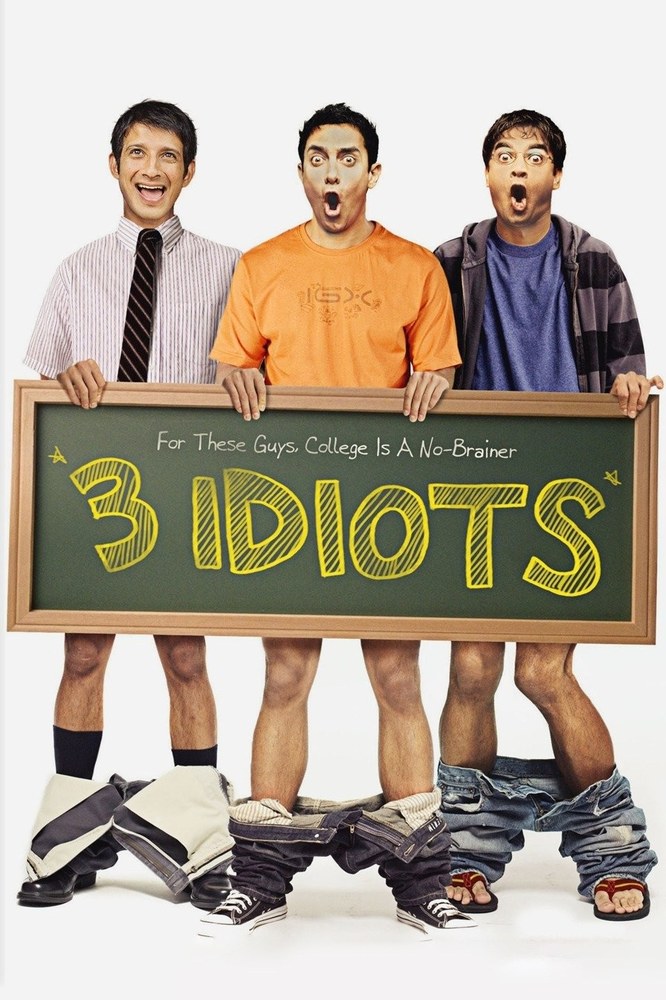
3 Idiots

3 Idiots

Movie · 2009 · 9 people

Rajkumar Hirani directed 3 Idiots, a 2009 Hindi-language comedy-drama co-written with Abhijat Joshi and produced by Vidhu Vinod Chopra under the Vinod Chopra Films banner. Loosely adapted from Chetan Bhagat's novel Five Point Someone, it follows the friendship of three students — Rancho, Farhan and Raju — who share a dorm room at one of India's most prestigious engineering colleges. Told through two parallel timelines, a present-day search and their campus years a decade earlier, the film balances humor and emotion while satirizing an education system driven by grades, family expectations and relentless competition.

Aamir Khan, R. Madhavan and Sharman Joshi star, with Kareena Kapoor, Boman Irani and Omi Vaidya in key roles; Khan's character was inspired by inventor Sonam Wangchuk, one of the creators of the real Indian inventions featured in the film. Released on December 25, 2009, it broke opening records to become the highest-grossing Indian film of its time and found rare success in East Asian markets such as China and Japan. It won three National Film Awards and six Filmfare Awards including Best Film, and was later remade in Tamil as Nanban and in Mexico as 3 Idiotas.

DirectorRajkumar Hirani
Production companyVinod Chopra Films
3 Idiots 3 Idiots 3 Idiots

Reactions

You can pick up to 3 reactions.

Cast

Names without a link have no profile here yet.

Aamir Khan Aamir Khan Actor · 61 years old Ranchoddas "Rancho" Chanchad R. Madhavan Sharman Joshi Kareena Kapoor Boman Irani Javed Jaffrey Omi Vaidya Mona Singh Parikshit Sahni

Through different eyes

AI-assisted editorial takes written from different viewer perspectives. They are not reader reviews; those are below.

Family Viewer Asks whether the whole household can watch it; cares about humor and heart.

It is a long film, so be ready to give it a whole evening. But for families with teenagers or university-age children it leaves plenty to talk about: pressure over grades, what parents expect, choosing your own path. The humor is mostly warm, at times in the spirit of a school prank. It suits teenagers watching with their parents better than small children.

History & Society Lens Asks about the period, the social background and what the work reflects.

The film's real strength is that its satire is aimed not at some random school but at a country's engineering colleges and the middle-class dreams tied to grade averages. Parents deciding their children's careers in advance, success measured only through competition: it may look specifically Indian, yet anyone who knows Turkey's exam culture will find it uncomfortably familiar. Basing Rancho on a real inventor also keeps the criticism from turning into an abstract complaint, since the film sets curiosity and making things against rote learning. Its success in markets such as China and Japan suggests how widely shared this problem is.

Cinephile Looks at script, editing and directing choices; keeps a distance from formula films.

The structure that cuts between two timelines is cleverly built: the present-day search gives the campus years a frame of curiosity and keeps the flashbacks from becoming a mere photo album. Its ambition to carry comedy and drama within the same scene largely pays off, but the balance does not always hold. The emotional peaks are sometimes underlined too heavily, the message is spelled out more than once, and some side episodes could easily have been trimmed in the edit. Writing the hero as an almost flawless sage also blunts the satire; once the system becomes a caricature, the critique loses its edge. It is an ambitious example of popular cinema carrying ideas to a mass audience.

Reviews (0)

Log in Log in to write a review.

Comments