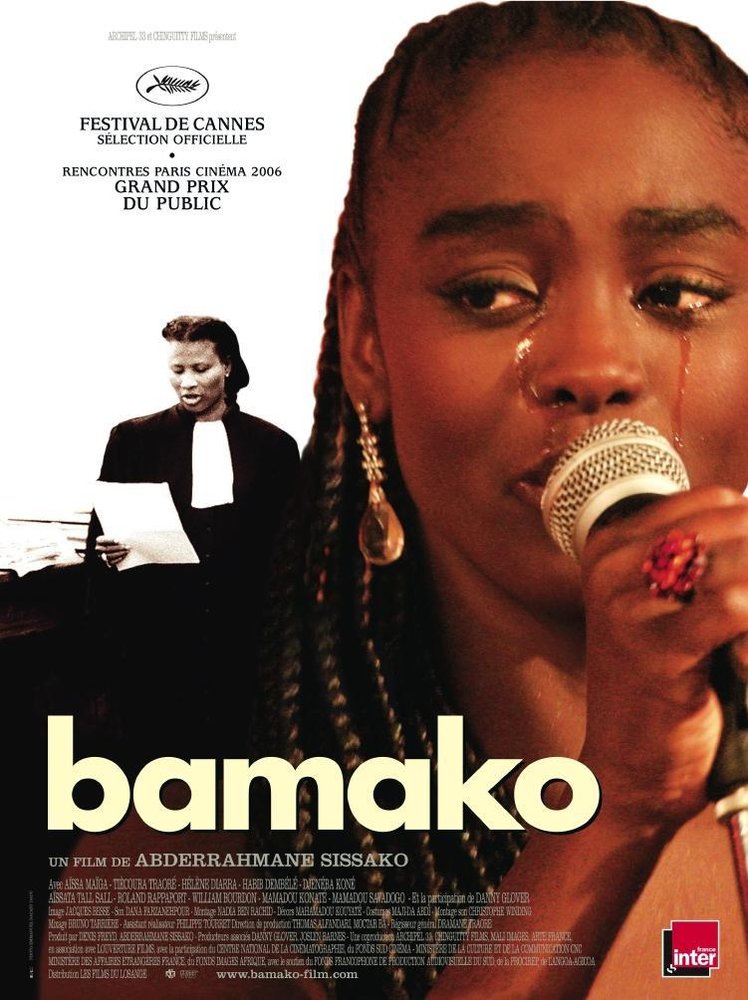
Bamako

Bamako

Movie · 2006 · 14 people

Through a fictional trial, Bamako examines what part the World Bank and the International Monetary Fund have played in Africa's poverty. Abderrahmane Sissako wrote and directed the 2006 docudrama, a French, American and Malian co-production. It was shot in French, Bambara and Senufo and runs about 115 minutes.

The story unfolds in the courtyard of a house in an outlying district of Bamako, the capital of Mali. In the makeshift court set up there, African civil society puts the two institutions in the dock. The plaintiffs argue over whether the continent's financial plight is due to international bodies serving the interests of rich countries, or to corruption and poor governance. The debate reaches back to European colonialism, asking how it shaped African societies and fed today's poverty. The cast features Aïssa Maïga, Habib Dembélé, Hélène Diarra, Aminata Dramane Traoré, William Bourdon, Danny Glover and Issa Doumbia.

The film had its world premiere out of competition at the Cannes Film Festival on 21 May 2006 and drew favourable reviews. Les Films du Losange released it in France on 18 October 2006, and New Yorker Films opened it in the United States on 14 February 2007. Sissako and Denis Freyd produced it.

DirectorAbderrahmane Sissako

Reactions

You can pick up to 3 reactions.

Cast

Only cast members with a profile on this site are listed.

Danny Glover Danny Glover Actor · 80 years old Issa Doumbia Issa Doumbia Film actor · 44 years old Aïssa Maïga Habib Dembélé William Bourdon Aminata Dramane Traoré Elya Süleyman Abderrahmane Sissako Jean-Henri Roger Zeka Laplaine Aissata Tall Sall Hamadoun Kassogué Roland Rappaport Mamadou Konaté

Through different eyes

History & Society Lens Asks about the period, the social background and what the work reflects.

Bamako's boldest move is taking the debate on the global economy out of conference halls and into a neighbourhood courtyard. Putting the World Bank and the IMF on trial before African civil society leaves the question of who is to blame for poverty open in both directions, outside institutions or corruption and poor governance, and that saves the film from being a one-sided indictment. Extending the debate back to European colonialism makes the historical roots of today's poverty visible. Leaving the question open rather than answering it looks like a deliberate choice that invites viewers to think instead of handing them a ready conclusion.

Cinephile Looks at script, editing and directing choices; keeps a distance from formula films.

Sissako's form stands out for its hybrid of documentary and fiction. Setting the trial in a house's courtyard is a strong staging idea that ties an abstract economic debate to a concrete place, and mixing French, Bambara and Senufo carries into the form itself the question of who gets to speak. Yet the film struggles to turn that idea into dramatic flow. The pace sags between long speeches and testimonies, and at times the film language goes no further than a recorded hearing. Its warm reception at Cannes reflects the strength of the idea, but a structure that demands this much patience is not for everyone.

Family Viewer Asks whether the whole household can watch it; cares about humour and heart.

A heavy, talk-driven film of debate. With its long courtroom speeches and subtitled passages, it is very unlikely to hold children's interest. It suits final-year high-school students and adults interested in economics, history and Africa. Not one for a family night, but for people who want to discuss and argue afterwards.

These are not reader reviews: they are short editorial takes written from different viewer perspectives with AI assistance. Reader reviews are below.

Reviews (0)

Log in Log in to write a review.

Comments