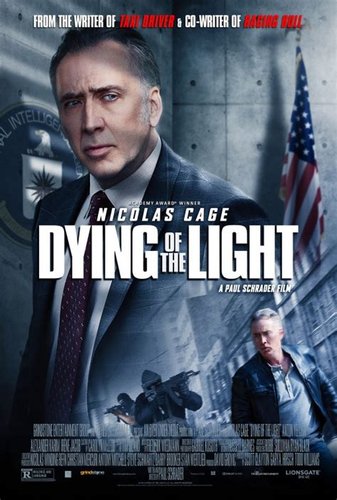
Dying of the Light

Dying of the Light

Movie · 2014 · 9 people

Dying of the Light is a 2014 American spy thriller about a retired CIA agent with dementia who sets out on a personal revenge hunt for the man who tortured him two decades earlier. Paul Schrader wrote and directed it. It was produced by Red Granite Pictures. Frederik Wiedmann composed the music.

Nicolas Cage plays the agent, Evan Lake. Lake learns that his torturer, Muhammad Banir (Alexander Karim), thought dead, is back, and with no help from his agency he takes his young colleague Milton Schultz (Anton Yelchin) along. As the illness erodes his memory and judgment, the pursuit becomes more obsessive and more dangerous. Irène Jacob plays Michelle Zuberain, and the cast also includes Victor Webster, Geff Francis, Adetomiwa Edun and Silas Carson.

The film was released by Lionsgate on December 5, 2014, both in cinemas and on VOD. Schrader was denied final cut and the studio reedited the footage without his consent. He and the principal cast disowned the released version and campaigned against it, and reports of Cage boycotting his own film surfaced at the time.

DirectorPaul Schrader
Production companyRed Granite Pictures

Reactions

You can pick up to 3 reactions.

Cast

Names without a link have no profile here yet.

Irène Jacob Irène Jacob Film actor · 60 years old Michelle Zuberain Nicolas Cage Anton Yelchin Victor Webster Alexander Karim Geff Francis Adetomiwa Edun Silas Carson Șerban Celea

Through different eyes

AI-assisted editorial takes written from different viewer perspectives. They are not reader reviews; those are below.

Action & Thriller Fan Puts pace, tension and set pieces first; little patience for slow drama.

The hook is great: a retired agent losing his memory goes after the man who tortured him. That could have made a tight, ticking thriller. But the version that reached screens met with brutal reviews, and neither the director nor the lead actors stood behind it. As released, it leaves its promise of pace and tension unkept; expectations are best kept low.

Cinephile Looks at script, editing and directing choices; keeps a distance from formula films.

This film is interesting less as a work than as the record of a dispute. Schrader wrote and directed it but did not have final cut; the studio re-edited the footage without his consent, and he and the principal cast disowned the result. So judging what we have as a Schrader film would be unfair. There is still something compelling at its core: a lonely man consumed by obsession. An edit that let the illness erode the film's own form along with its hero's judgment could have turned a routine revenge thriller into something far more distinctive. What remains is a footnote in film history, a case study in what losing creative control can cost a picture.

History & Society Lens Asks about the period, the social background and what the work reflects.

The most interesting thing about the film is that it places aging and dementia inside the spy-thriller mold. The fact that Evan Lake gets no help at all from his agency raises a sobering question about how someone who gave years to an institution can be pushed aside once he falls ill. A man with a failing memory trying to settle accounts with a torture trauma from two decades earlier also blurs the line between personal revenge and institutional responsibility. These themes, however, are overshadowed by the fight over the film's edit. Viewers looking for a serious treatment of dementia will find a starting point here at best.

Reviews (0)

Log in Log in to write a review.

Comments