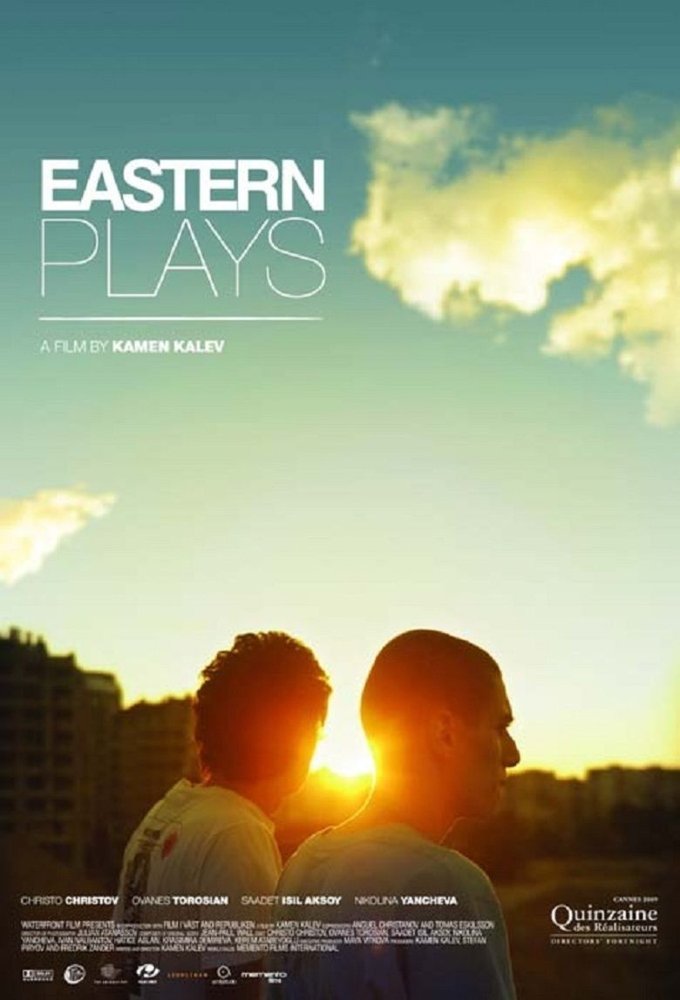
Eastern Plays (Iztochni piesi)

Eastern Plays (Iztochni piesi)

Movie · 2009 · 7 people

Kamen Kalev, a La Fémis graduate, wrote and directed his first feature himself: the 2009 Bulgarian drama Eastern Plays (in Bulgarian, Iztochni piesi). The film was first presented at the Sarajevo Film Festival, then screened in the Directors' Fortnight at the 2009 Cannes Film Festival; in Bulgaria it opened on October 6, 2009, in Burgas and October 16 in Sofia. Bulgaria chose it as its entry for the 2010 Oscars. In Turkey it opened as Şark Oyunları on April 9, 2010.

The story takes place in Sofia. Itso, who fights drug addiction and earns a living as a woodcarver, and his younger brother Georgi have drifted apart. Georgi joins an attack by the neo-Nazi group he has just entered, while Itso rescues the Turkish family it targets. Georgi begins to question his place in the movement, and Itso wonders whether the young Turkish woman he saved could be an escape from his unhappy life. The brothers see what they truly want only when they are forced together. Hristo Hristov, Ovanes Torosyan, Saadet Aksoy and Nikolina Yancheva lead the cast.

Shooting was mainly in Sofia, with some scenes in Istanbul. Post-production was done on a laptop because of the small budget. The film runs about 83 minutes.

DirectorKamen Kalev
Eastern Plays (Iztochni piesi)

Reactions

You can pick up to 3 reactions.

Cast

Names without a link have no profile here yet.

Saadet Aksoy Saadet Aksoy Actor · 43 years old Isil Hatice Aslan Hatice Aslan Actor · 64 years old Isil's Mother Ivan Nalbantov Kerem Atabeyoğlu Anjela Nedyalkova Ovanes Torosyan Irmena Chichikova

Also in the cast: Hristo Hristov, Nikolina Yancheva (Niki)

Through different eyes

Cinephile Looks at script, editing and directing choices; keeps a distance from formula films.

Kamen Kalev's debut makes no effort to hide its small budget, and in my view that is part of its strength. Finishing post-production on a laptop fits the film's bare, unadorned visual language; Sofia comes across not as a postcard but as a tired city. Running the two brothers along parallel lines lets us read one's slide into violence against the other's turn as a rescuer. My reservation: Itso seeing the young woman he saved as a possible way out risks becoming a symbol in the script rather than a character. Still, its selection for the Directors' Fortnight at Cannes is no surprise; this is a disciplined first feature with nothing ornamental about it.

History & Society Lens Asks about the period, the social background and what the work reflects.

The film approaches xenophobia from a place Turkish viewers will recognize: a Turkish family attacked in Sofia. Setting a neo-Nazi group's pull on a young recruit beside the dead end of a craftsman fighting addiction paints a picture of urban youth whose emptiness gets filled by anger. The neighborly ties between Bulgaria and Turkey form a quiet layer in the background, made visible by the scenes shot in Istanbul. The film avoids an easy moral lesson; one brother beginning to question himself can be read as a call for a society to look in the mirror.

Family Viewer Asks whether the whole household can watch it; cares about humor and heart.

This is not one to put on casually with the family. The story involves drug addiction and a racist attack on a family, which is too heavy for children, and the overall mood is dark and bleak. For adults and older teenagers, though, it can be a good starting point for talking about racism, brotherhood and choosing the right path. Pick it knowingly, and save it for after the little ones are in bed.

These are not reader reviews: they are short editorial takes written from different viewer perspectives with AI assistance. Reader reviews are below.

Reviews (0)

Log in Log in to write a review.

Comments