Farha

Farha

Movie · 2021 · 3 people

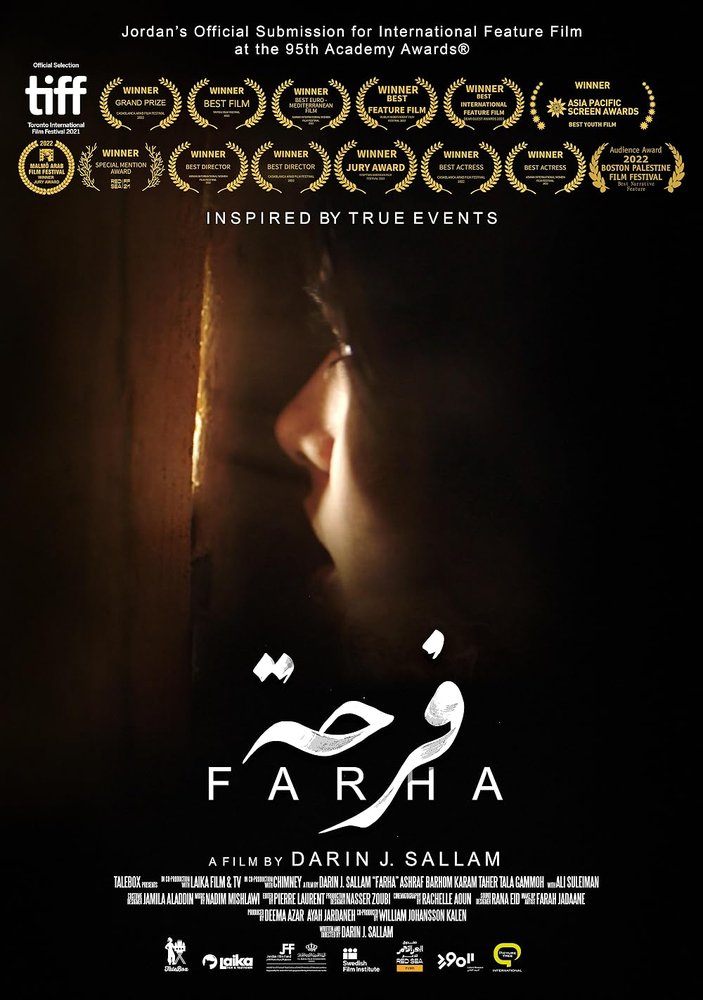
Darin J. Sallam, a filmmaker from Jordan, both scripted and directed Farha (Arabic for "joy"), a 2021 drama set in the past and made as an international co-production. A young Palestinian girl grows up amid the Nakba of 1948, when her people were driven from their land, and the film tells that coming of age through her experience. It is described as a Swedish, Saudi and Jordanian co-production. It won the Asia Pacific Screen Award for Best Youth Feature Film.

The story takes place in 1948 in a Palestinian village. Seen through a young girl's eyes, it follows a girl forced to grow up early as violence closes in, and what happens to her village. The screenplay draws on a true story about a girl named Radiyyeh, which Sallam was told as a child. Ashraf Barhom, Ali Suliman and Karam Taher are in the cast. English, Arabic and Hebrew are spoken in the film.

Farha had its world premiere at the Toronto Film Festival on September 14, 2021, and began streaming on Netflix on December 1, 2022. It is described as the first Nakba-themed fiction film on Netflix. Its depiction of the killing of a Palestinian family drew criticism from right-wing Israeli politicians.

DirectorDarin Sallam

Reactions

You can pick up to 3 reactions.

Cast

Names without a link have no profile here yet.

Through different eyes

AI-assisted editorial takes written from different viewer perspectives. They are not reader reviews; those are below.

Cinephile Looks at script, editing and directing choices; keeps a distance from formula films.

The film's defining formal choice is to limit its point of view to a single young girl. Rather than staging the great historical narrative in wide shots, Darin Sallam keeps events within the bounds of a child's perception, so the violence is felt not as a panorama but as a shrinking world. The fact that the script draws on the true story of a girl named Radiyyeh gives the storytelling the weight of testimony. That single viewpoint has a cost, though: the supporting characters inevitably stay faint, and the wider context is left largely to what the viewer already knows. It is a deliberate, consistent restriction, but for someone unfamiliar with the history the film may at times feel like an incompletely told fragment.

History & Society Lens Asks about the period, the social background and what the work reflects.

Farha brings the 1948 Nakba, the year Palestinians were driven from their land, down to the scale of one village and one girl. Events like these are usually told through numbers and maps; the film shows the same history from inside the narrowing limits of a single life. Its standing as the first Nakba-themed fiction film on Netflix, and the backlash from right-wing Israeli politicians against its depiction of the killing of a Palestinian family, show how contested the memory of 1948 still is. That it is a Swedish, Saudi and Jordanian co-production also points to a need to tell this story beyond the region itself.

Family Viewer Asks whether the whole household can watch it; cares about humor and heart.

It looks like a girl's coming-of-age story, but violence closes in, and the killing of a family is shown on screen. It is definitely not suitable for young children. Older teenagers interested in history could watch it with an adult; it is heavy enough that you will need to talk about it afterwards.

Reviews (0)

Log in Log in to write a review.

Comments