The First Day of the Rest of Your Life (Le premier jour du reste de ta vie)

The First Day of the Rest of Your Life (Le premier jour du reste de ta vie)

Movie · 2008 · 15 people

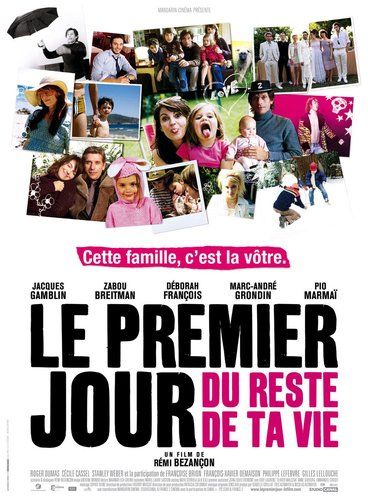
Le premier jour du reste de ta vie (The First Day of the Rest of Your Life) is a 2008 French comedy-drama that traces a middle-class family of five over nearly twelve years through five days that change its course. Rémi Bezançon wrote and directed it. A hit with French audiences, it was followed by a run of similar productions in French cinema.

The structure is episodic: each chapter centers on a different period and a different member of the family. The ups and downs of family life are blended with comedy, and familiar moments such as growing up, leaving home and coming back together are treated with warm humor. Jacques Gamblin plays the father, Robert, and Zabou Breitman the mother, Marie-Jeanne. Déborah François plays Fleur and Marc-André Grondin plays Raphaël, with Pio Marmaï also in the cast. Cécile Cassel, Gilles Lellouche and François-Xavier Demaison appear too.

The film was produced by Mandarin with partners including Canal+ and France 2. It was nominated for nine César Awards and won three: Best Editing, Most Promising Actor and Most Promising Actress.

DirectorRémi Bezançon
Production companyMandarin et Compagnie - Mandarin Télévision

Reactions

You can pick up to 3 reactions.

Cast

Names without a link have no profile here yet.

Françoise Brion Françoise Brion Actor · died at 92 The Owner of the Injured Dog Camille de Pazzis Cécile Cassel Déborah François François-Xavier Demaison Gilles Lellouche Jacques Gamblin Jean-Jacques Vanier Marc-André Grondin Sinclair Océane Loison Philippe Lefebvre Pio Marmaï Raphaël Bouvet Roger Dumas

Also in the cast: Zabou Breitman (Marie-Jeanne Duval)

Through different eyes

AI-assisted editorial takes written from different viewer perspectives. They are not reader reviews; those are below.

Cinephile Looks at script, editing and directing choices; keeps a distance from formula films.

Rémi Bezançon's film escapes the most dangerous trap of the family drama, the tedium of telling everything in a chronological flow, through a clever structural choice. Splitting nearly twelve years into five pivotal days and telling each chapter through a different family member keeps the rhythm alive and lets us see the same events from different angles. It is no accident that one of its three César awards went to the editing: the transitions between chapters are the film's real achievement. The music, too, carries much of the story's emotion. The episodic structure gives some characters more room to breathe than others, and not every chapter is equally strong.

Family Viewer Asks whether the whole household can watch it; cares about humor and heart.

Growing up, leaving home and coming back together: moments every family will recognize. The film tells them with warm humor. But it is a family story better suited to teenagers and adults than to small children. Watched with teens, it can be a good opening to talk about relationships within the family.

History & Society Lens Asks about the period, the social background and what the work reflects.

By spreading the life of a middle-class French family over twelve years, the film lets us read how the family as an institution changes through small moments. Children growing up, leaving home and the distance between generations are issues familiar in many societies. Focusing each chapter on a different family member is a reminder that everyone in a family lives the same story differently. On the other hand, the film stays within the world of one middle-class family; questions such as class difference are not at the heart of the story. That makes it universal but leaves it somewhat limited in social terms.

Reviews (0)

Log in Log in to write a review.

Comments