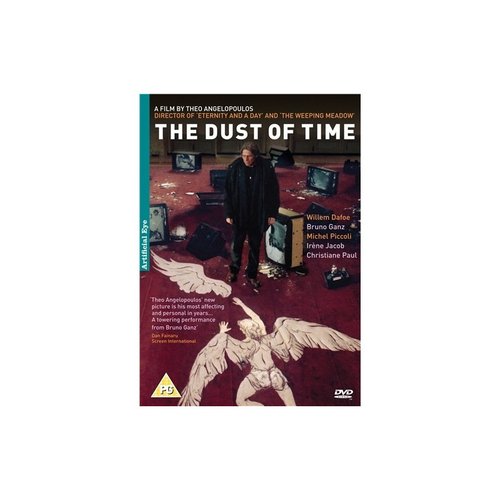
The Dust of Time

The Dust of Time

Movie · 2008 · 10 people

The Dust of Time (Greek I Skóni tou Hrónou), a 2008 drama, comes from the Greek director Theodoros Angelopoulos. A Greek, Italian and French co-production shot in English, it runs about 125 minutes. Angelopoulos directed and co-wrote it, and it was conceived as the second film of a trilogy he left unfinished. The series began in 2004 with The Weeping Meadow, and the closing chapter was never completed because of his unexpected death in January 2012.

The leads are Willem Dafoe, Irène Jacob, Bruno Ganz, Michel Piccoli and Christiane Paul, with Valentina Carnelutti, Alexandra Maria Lara and Nenad Lucic also in the cast. Angelopoulos wrote the screenplay with Tonino Guerra and Petros Markaris, and Eleni Karaindrou composed the music. By the director's own account, his films are chapters of one large book about human destiny and time.

The film had its world premiere on 12 February 2009 at the 59th Berlin Film Festival and drew praise from critics. In France it reached cinemas only on 13 February 2013, more than five years after it was finished. Known there as La Poussière du temps, it was meant to be followed by a third part, under the working title The Other Sea, which was never made.

DirectorTheodoros Angelopoulos
The Dust of Time The Dust of Time

Reactions

You can pick up to 3 reactions.

Cast

Only cast members with a profile on this site are listed.

Irène Jacob Irène Jacob Film actor · 60 years old Willem Dafoe Bruno Ganz Michel Piccoli Christiane Paul Valentina Carnelutti Alexandra Maria Lara Nenad Lucic Herbert Meurer Anja Laïs
Through different eyes

Cinephile Looks at script, editing and directing choices; keeps a distance from formula films.

The Dust of Time is hard to judge on its own, because Angelopoulos conceived it as the middle part of a trilogy he never finished. His view of his films as chapters of one large book about human destiny and time is both a strength and a burden here: as the continuation of a story begun in The Weeping Meadow, the film never fully closes on itself. The screenplay, written with Tonino Guerra and Petros Markaris, builds a structure more interested in the passing of time than in plot, and Eleni Karaindrou's score follows that tone. In my view the real question is whether an English-language international co-production keeps the density we associate with the director. The critical praise suggests it does, but this is not the door through which to start with Angelopoulos.

History & Society Lens Asks about the period, the social background and what the work reflects.

The circumstances around the film say as much as its own story. Shot in English as a Greek, Italian and French co-production, with a cast drawn from different European cinemas, it reflects a period when art cinema could only survive through cross-border collaboration. That it took more than five years to reach French cinemas despite praise in Berlin shows how hard such films find distribution. The trilogy left unfinished by the director's death gives the film an unintended air of farewell. This context makes it more meaningful, but it doesn't make it any easier to watch.

Family Viewer Asks whether the whole household can watch it; cares about humour and heart.

This isn't a family movie night pick. Its storytelling is heavy, reflective and demands patience, dealing with big themes such as human destiny and time. Children and teenagers will most likely lose interest quickly. It suits adults who enjoy slow art films; anyone after something light should pick another film.

These are not reader reviews: they are short editorial takes written from different viewer perspectives with AI assistance. Reader reviews are below.

Reviews (0)

Log in Log in to write a review.

Comments