Leyleğin Geciken Adımı

The Suspended Step of the Stork (To meteoro vima tou pelargou)

Movie · 1991 · 12 people

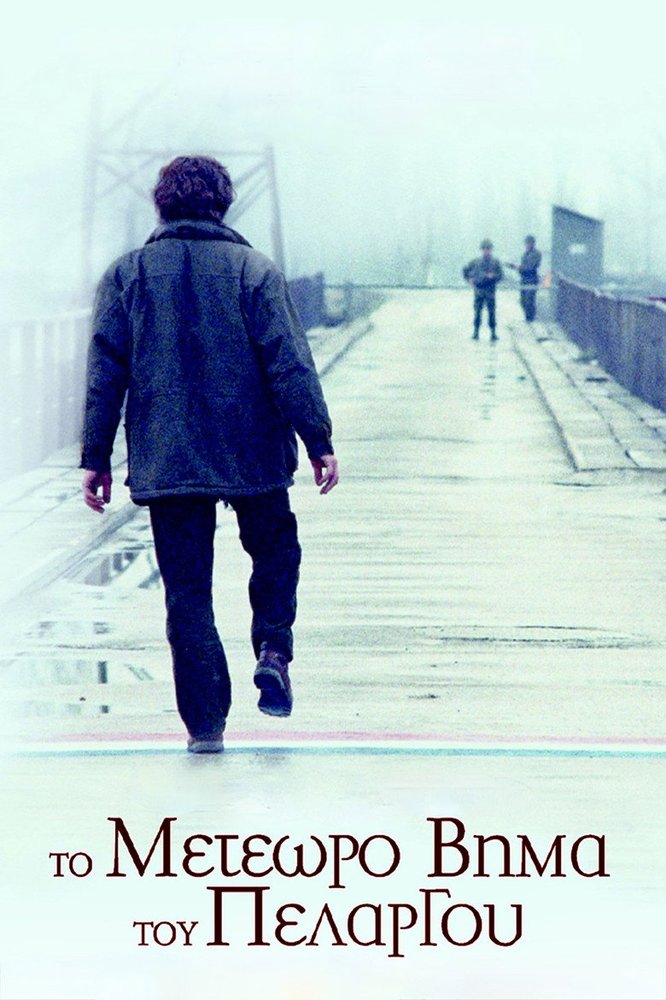
Theodoros Angelopoulos directed The Suspended Step of the Stork (Greek: To meteoro vima tou pelargou), a 1991 drama. A Greek-Italian-French co-production of about 143 minutes, it stars Marcello Mastroianni and Jeanne Moreau. It is the first film in the director's trilogy about borders, followed by Ulysses' Gaze and Eternity and a Day; Angelopoulos treats the frontier as a threshold in communication, in love and in the passage from life to death.

At the center is Alexandre, a young television reporter whose assignment takes him to an unnamed Greek border town. The town is a crossing point for refugees, and the soldiers' traditional ceremonial changing of the guard adds tension. Among the refugees Alexandre is struck by the face of an elderly man living almost like a hermit, and he begins to suspect he is a Greek politician who vanished years ago. Angelopoulos wrote the screenplay with Tonino Guerra and Petros Markaris; Gerasimos Skiadaressis also appears.

The film portrays 1990s Europe, where new walls were rising just as the Cold War ended, through the themes of borders and failed communication. It played in the main competition at the 1991 Cannes Film Festival, losing the Palme d'Or to Barton Fink. Its first Greek run drew 60,000 viewers, double the combined audience of the year's ten other Greek releases.

DirectorTheodoros Angelopoulos

Reactions

You can pick up to 3 reactions.

Cast

Only cast members with a profile on this site are listed.

Marcello Mastroianni Marcello Mastroianni Actor · died at 72 Jeanne Moreau Jeanne Moreau Film actor · died at 89 Gerasimos Skiadaresis Christoforos Nezer Dimitris Poulikakos Gregory Patrikareas Ilias Logothetis Vasilis Bouyiouklakis Mihali Yanatos Athinodoros Prousalis Akis Sakellariou Dora Chrysikou

Through different eyes

Cinephile Looks at script, editing and directing choices; keeps a distance from formula films.

The film that opens Angelopoulos's border trilogy turns the director's slow rhythm into a tool for thinking. Treating the border not just as a line on a map but as a threshold in communication, in love and in the passage from life to death gives it an abstract yet coherent backbone. Written with Tonino Guerra and Petros Markaris, the script builds a detective-style curiosity around a young reporter searching an old man's face for a vanished politician, but its real interest is the question of identity itself. Mastroianni and Moreau lend the production weight, yet the true protagonist is the nameless border town full of refugees. The fair criticism, in my view, is the length this language demands patience for; carrying the story on atmosphere rather than events will not suit everyone.

History & Society Lens Asks about the period, the social background and what the work reflects.

The film captures a moment when the Cold War was ending yet new walls were rising in Europe, which makes it strikingly prescient for 1991. Having an unnamed Greek border town serve as a crossing point for refugees is a reminder that migration is not just a headline but a state of waiting in which people are stuck. Making the hero a television reporter also raises the question of how the media look at people at the border. Given that borders and refugees are still debated in Europe today, it remains a period testimony that has kept its relevance.

Family Viewer Asks whether the whole household can watch it; cares about humour and heart.

This is not a film for family night. It deals with heavy subjects like refugees, border tension and a politician who vanished, and its storytelling is calm and long. Children will find it dull, and even teenagers may struggle. For patient adults who enjoy art-house cinema, though, it is a film worth long conversations afterwards. Best watched by grown-ups on their own.

These are not reader reviews: they are short editorial takes written from different viewer perspectives with AI assistance. Reader reviews are below.

Reviews (0)

Log in Log in to write a review.

Comments