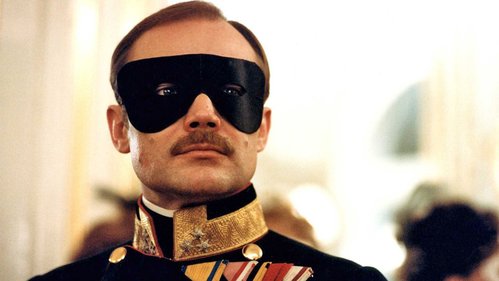
Albay Redl

Colonel Redl (Oberst Redl)

Movie · 1985 · 15 people

Hungarian director István Szabó made Colonel Redl (Oberst Redl), a biographical drama, in 1985. An Austrian, German and Hungarian co-production backed by ORF and ZDF, it draws on the life of Alfred Redl, who rose through the Austro-Hungarian army before World War I. It forms the middle part of Szabó's trilogy that begins with Mefisto and ends with Hanussen, all about a man who seeks self-fulfilment, is forced into compromises by circumstances and is ruined.

Redl, from a humble family, enters military school as a boy, builds a career on loyalty to the crown and is put in charge of an intelligence unit. His attraction to men, together with tangled political intrigue, leads to his downfall. Klaus Maria Brandauer leads, with Gudrun Landgrebe and Jan Niklas; Károly Eperjes and Can Togay, a Hungarian actor of Turkish descent, are also in the cast. The script is inspired by John Osborne's play A Patriot for Me.

It premiered in Hungary on 20 February 1985 and in Germany on 29 March. Its credits state that the events are products of fantasy. Running 144 minutes, it won the Jury Prize at Cannes and the BAFTA for Best Film Not in the English Language, and was nominated for an Oscar and a Golden Globe in the same category.

DirectorIstván Szabó
Production companyORF

Reactions

You can pick up to 3 reactions.

Cast

Only cast members with a profile on this site are listed.
Can Togay Can Togay Actor · 71 years old Károly Eperjes Károly Eperjes Film actor · 72 years old Klaus Maria Brandauer Gudrun Landgrebe Armin Mueller-Stahl Hans Christian Blech Jan Niklas András Bálint László Gálffi Dorottya Udvaros Flóra Kádár Péter Andorai Gábor Ferenczi Sándor Simó Péter Dobai
Through different eyes

Cinephile Looks at script, editing and directing choices; keeps a distance from formula films.

In the middle film of the trilogy he began with Mefisto, István Szabó asks his familiar question again: how much can someone who wants to fulfil himself concede to the system? Klaus Maria Brandauer plays Redl as a man who turns loyalty into a career strategy while always carrying an outsider inside him, and his performance is the film's backbone. Drawing on John Osborne's play gives the scenes a theatrical weight that sometimes builds intensity and sometimes simply slows things down. Over 144 minutes the rhythm isn't always alive, and the intrigues knot together in the middle stretch. Still, the Jury Prize at Cannes comes as no surprise: this is serious cinema that moves past costume drama to think about identity and power.

History & Society Lens Asks about the period, the social background and what the work reflects.

The film follows a boy from a humble family in pre-First World War Austria-Hungary as military school carries him into the heart of the state. What is most interesting is the price of climbing the social ladder: Redl's loyalty to the crown shapes both his rise and his vulnerability. His attraction to men, combined with tangled political intrigue, sets up his fall and shows how a private life could be turned into a weakness in the army of that era. Although it draws on the life of a real officer, the credits say the events are products of fantasy, and that matters: it is better watched not as a historical record but as a reading of the mood of an empire coming apart.

Action & Thriller Fan Puts pace, tension and set pieces first; little patience for slow drama.

An intelligence unit, political intrigue, pre-war tension… On paper it looks like a spy film, but it isn't one. This is a slow-moving, 144-minute character drama where a man's inner life and career calculations matter far more than confrontation. Brandauer is impressive, no argument there. But anyone expecting a fast thriller may start checking the clock halfway through; it needs a patient evening.

These are not reader reviews: they are short editorial takes written from different viewer perspectives with AI assistance. Reader reviews are below.

Reviews (0)

Log in Log in to write a review.

Comments