Attila

Attila

Movie · 1954 · 15 people

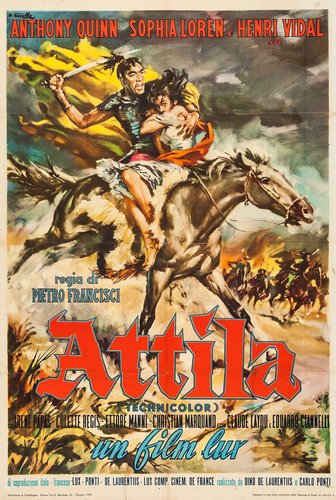
One of the early sword-and-sandal films, Attila turns the life of Attila the Hun into a historical drama. It was made in 1954 as an Italian-French co-production. Pietro Francisci directed, while Dino De Laurentiis and Carlo Ponti produced for Lux Film; the Italian original title is Attila, il flagello di Dio and the French one Attila fléau de Dieu.

Anthony Quinn plays Attila. Sophia Loren is Honoria, and the French leading man Henri Vidal is the Roman commander Flavius Aetius, the Hun king's antagonist. Irene Papas, in the second of three contract pictures for Lux Film, plays Grune, one of Attila's wives. The supporting cast includes Ettore Manni, Christian Marquand, Claude Laydu and Guido Celano; the American actor Scott Marlowe made his screen debut here.

The film was shot right after Ulysses (1954), the same team's Italian-American co-production. The producers meant to use an American lead to license the film to an American studio on better terms, and for several unforeseen reasons that failed at first. Three and a half years later, re-released as Attila, it launched Joseph E. Levine's career as a producer and distributor of international films and counted as one of Loren's biggest box-office successes of the 1950s.

DirectorPietro Francisci
Production companyLux Film

Reactions

You can pick up to 3 reactions.

Cast

Names without a link have no profile here yet.

Guido Celano Guido Celano Actor · died at 83 Tribe Chief Anthony Quinn Sophia Loren Irene Papas Henri Vidal Ettore Manni Marco Guglielmi Eduardo Ciannelli Carlo Hintermann Mimmo Palmara Mario Feliciani Christian Marquand Claude Laydu Colette Régis Fernando Birri

Also in the cast: Scott Marlowe

Through different eyes

AI-assisted editorial takes written from different viewer perspectives. They are not reader reviews; those are below.

Action & Thriller Fan Puts pace, tension and set pieces first; little patience for slow drama.

One of the early sword-and-sandal films: the Hun ruler on one side, the Roman commander Aetius on the other, which promises a big showdown. For anyone used to the genre's later, faster entries, though, the pace may feel heavy today. The clash between Attila and Aetius is the film's main source of tension. Interesting if you care about genre history; too stately if you want a fast-moving war film.

History & Society Lens Asks about the period, the social background and what the work reflects.

In Turkey, Attila is usually remembered as the great ruler of Hun history. The film's original Italian title, by contrast, calls him "the scourge of God", looking at the story through the fears of Rome and Europe. For a Turkish viewer that difference may be the most instructive thing about the film: it shows how differently the same historical figure lives on in the memory of different societies. Bringing in real historical figures such as Honoria and Flavius Aetius is a plus. By the nature of the genre this is a historical drama that leans towards spectacle rather than fidelity, and it should not be read as a history source.

Cinephile Looks at script, editing and directing choices; keeps a distance from formula films.

What makes Attila interesting today is less what is on screen than the production logic behind it. The producers were aiming at the international market with an American lead and planned to license the film to an American studio; that failed at first, but the re-release years later launched Joseph E. Levine's career as a producer and distributor. The film is, in other words, an early document of how European co-productions courted the American market. Pietro Francisci's direction bears the marks of that commercial calculation: the stars are put in the shop window and the story is arranged around them. Having Sophia Loren and Irene Papas in the same cast is a draw for film history buffs, but the dramatic structure leans on moments of spectacle more than on character.

Reviews (0)

Log in Log in to write a review.

Comments