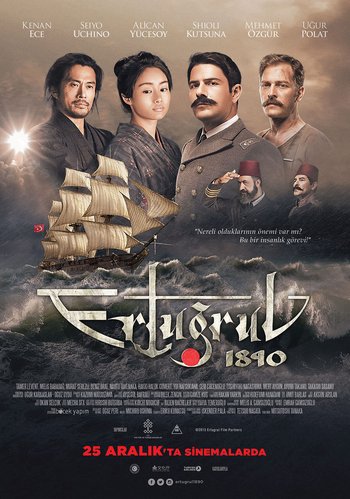
Ertuğrul 1890

125 Years Memory

Movie · 2015 · 4 people

Two real events that strengthened the friendship between Japan and Türkiye come together in Ertuğrul 1890, a Japanese-Turkish historical drama from 2015. Known in Japan as Kainan 1890 and in English as 125 Years Memory, it was directed by Mitsutoshi Tanaka and made by Toei and Creators' Union with Böcek Yapım. It opened in Japan on 5 December 2015 and in Türkiye on 25 December 2015.

The first half follows the Ottoman frigate Ertuğrul, which sailed to Japan in 1890 and was caught in a storm on the way home, striking rocks off Wakayama. More than five hundred people died, but poor villagers risked their lives to rescue sixty-nine survivors. The second half moves to 1985: during the Iran-Iraq War, Iraq announced it would shoot down aircraft over Iran, and a Turkish plane sent on Turgut Özal's orders evacuated more than three hundred stranded Japanese from Tehran before the deadline ran out.

The cast includes Seiyo Uchino, Kenan Ece, Shiori Kutsuna, Alican Yücesoy, Uğur Polat and Mehmet Özgür. Eriko Komatsu wrote the script. At the 39th Japan Academy Film Prizes in March 2016 it won in ten categories, taking first place for art direction and sound recording. In Türkiye it sold 451,794 tickets.

DirectorMitsutoshi Tanaka
Production companyToei, Creators' Union, Böcek Yapım

Reactions

You can pick up to 3 reactions.

Cast

Through different eyes

History & Society Lens Asks about the period, the social background and what the work reflects.

Ertuğrul 1890 combines two real events to look at the historical roots of Turkish-Japanese friendship: the Ottoman frigate that sank off Wakayama in 1890 and the evacuation of Japanese citizens from Tehran in 1985. These two events, about a century apart, aim to show people being bound by a sense of debt to one another more than states. This frame of mutual kindness works both emotionally and diplomatically; yet placing historical events at the service of a friendship narrative can encourage simplified detail. That it is a co-production bringing together the memories of two societies is interesting in itself.

Cinephile Looks at script, editing and directing choices; keeps a distance from formula films.

The film sets up two separate stories: the 1890 sea disaster and the 1985 evacuation. This two-part structure is ambitious, but the risk is plain: if the halves do not connect, it can read like two short films. Within 132 minutes, the disaster narrative of the first half and the political tension of the second have to settle into the same tone. Being a Japanese-Turkish co-production with names like Seiyo Uchino in the cast gives it an international scale, but scale alone does not bring unity. The biggest danger in such a historical account is expecting emotion from music and emphasis rather than from the images.

Action & Thriller Fan Puts pace, tension and set pieces first; little patience for slow drama.

Two stories, two big crises: first a ship hitting rocks in a storm, then an evacuation racing the clock out of Tehran. On paper that means two separate lines of tension; disaster and time pressure are exactly the material I like. The only issue is 132 minutes split into two halves; the rhythm may snap on the way into the second. Not a bad choice for fans of tension and drama, or anyone interested in historical events.

These are not reader reviews: they are short editorial takes written from different viewer perspectives with AI assistance. Reader reviews are below.

Reviews (0)

Log in Log in to write a review.

Comments