Las 13 rosas

Las 13 rosas

Movie · 2007 · 15 people

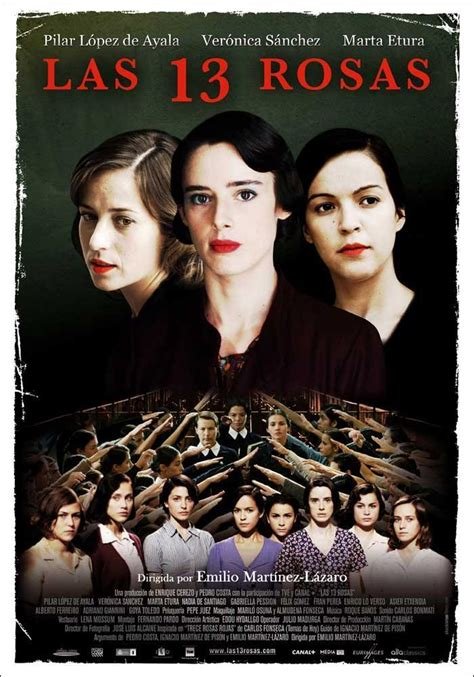
A real tragedy from the end of the Spanish Civil War reaches the screen in Las 13 rosas (13 Roses), a Spanish-Italian historical drama from 2007. Emilio Martínez-Lázaro directed it, working from Carlos Fonseca's book Trece rosas rojas. It earned fourteen Goya Award nominations and won four, for cinematography, costume design, original score and best supporting actor.

The story opens in the first days of the Franco regime, in the summer of 1939, and centres on the thirteen young women remembered as "Las Trece Rosas", the Thirteen Roses. Most belonged to the Unified Socialist Youth. They are arrested on the accusation of helping an assassination attempt against Franco, subjected to harsh interrogation and jailed. Despite their insistence on their innocence, all thirteen are quickly handed the heaviest sentence. Pilar López de Ayala plays Blanca, Verónica Sánchez plays Julia, Gabriella Pession plays Adelina and Marta Etura plays Virtudes, with Asier Etxeandía also in the cast. The film dwells on the women's refusal to give up their ideals and ends with the firing squad of 5 August 1939.

Ignacio Martínez de Pisón, Pedro Costa and Martínez-Lázaro wrote the screenplay together, and Roque Baños composed the score.

DirectorEmilio Martínez-Lázaro

Reactions

You can pick up to 3 reactions.

Cast

Only cast members with a profile on this site are listed.

Asier Etxeandía Asier Etxeandía Actor · 51 years old Jasmine Trinca Jasmine Trinca Actor · 45 years old Goya Toledo Pilar López de Ayala Gabriella Pession Miren Ibarguren Adriano Giannini Enrico Lo Verso Marta Etura Verónica Sánchez Nadia de Santiago Fran Perea Bárbara Lennie Luisa Martín Secundino de la Rosa Márquez

Through different eyes

History & Society Lens Asks about the period, the social background and what the work reflects.

Las 13 rosas tells the true story of thirteen young women handed the heaviest sentence in the first days of the Franco regime, right after the Spanish Civil War. Its importance lies in showing the repression that began the moment the war ended: the front lines have fallen silent, but violence continues, now at the hands of the state. That most of the women belonged to the Unified Socialist Youth invites reflection on how the new regime targeted young, politically active women. A valuable starting point for anyone trying to understand Spain's reckoning with its recent past. Still, dramatising a historical tragedy risks turning real people into symbols; the film is best read alongside sources such as Carlos Fonseca's book.

Cinephile Looks at script, editing and directing choices; keeps a distance from formula films.

Four wins from fourteen Goya nominations: cinematography, costume design, original score and best supporting actor. That spread sums up the film's strengths well; Emilio Martínez-Lázaro's film is above all a carefully crafted period reconstruction, with Roque Baños's score carrying the emotional tone. The real challenge lies in the script: turning thirteen women into distinct characters is hard, and as Blanca, Julia, Adelina and Virtudes come to the fore, the others risk remaining part of a collective portrait. The three writers make the honest choice of focusing on the women's ideals, but the sheer emotional weight of the subject at times pushes the storytelling to the edge of melodrama.

Family Viewer Asks whether the whole household can watch it; cares about humour and heart.

A heavy film about a real historical tragedy. Arrests, harsh interrogations, prison and execution are not subjects for young children. But it can be watched with high-school-age teens curious about the Spanish Civil War; it leaves plenty to talk about afterwards. There is no humour and the emotional weight is high. Sit down knowing that.

These are not reader reviews: they are short editorial takes written from different viewer perspectives with AI assistance. Reader reviews are below.

Reviews (0)

Log in Log in to write a review.

Comments