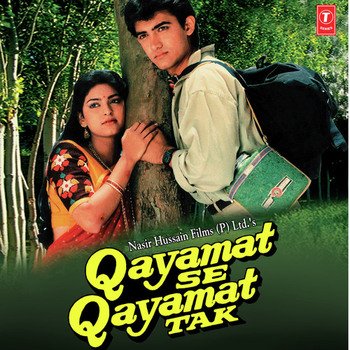
Qayamat Se Qayamat Tak

Qayamat Se Qayamat Tak

Movie · 1988 · 4 people

Released on April 29, 1988, the Hindi romantic musical Qayamat Se Qayamat Tak takes its name from a phrase meaning "from doomsday to doomsday". Nasir Hussain wrote and produced it, and it was the first film Mansoor Khan directed. The music is by Anand-Milind and the lyrics by Majrooh Sultanpuri. Aamir Khan and Juhi Chawla share the lead roles, and the film marked the screen debut of both.

The story follows Raj and Rashmi, two young people from families bound in a bitter feud, who fall in love, elope against their families' wishes and face the aftermath. Inspired by Shakespeare's Romeo and Juliet, it is a modern take on the classic tragic romance.

Made on a budget of about 25 million rupees, the film grossed 50 million rupees worldwide and became the year's third highest earner. At the 34th Filmfare Awards it won eight of eleven nominations, including Best Film and Best Director and both leads' debut awards. At the 36th National Film Awards it took Best Popular Film Providing Wholesome Entertainment. Its soundtrack sold more than eight million copies, launching Udit Narayan and Alka Yagnik. Seen as a milestone for 1990s Hindi romantic musicals, it was also remade in Telugu in 1996 as Pawan Kalyan's debut film.

DirectorMansoor Khan

Reactions

You can pick up to 3 reactions.

Cast

Names without a link have no profile here yet.

Aamir Khan Aamir Khan Actor · 61 years old Raj Juhi Chawla Dalip Tahil Alok Nath

Through different eyes

AI-assisted editorial takes written from different viewer perspectives. They are not reader reviews; those are below.

Cinephile Looks at script, editing and directing choices; keeps a distance from formula films.

Watched today, the film can feel familiar in places, but that is because so many romantic musicals that followed it took up its mold; such is the fate of the works that set the template. What stands out in Mansoor Khan's first film is how deftly it sets the Romeo and Juliet frame inside a local family feud and places its songs at the story's emotional pressure points. Anand-Milind's score is the film's load-bearing column, as album sales of more than eight million attest. My reservation is that the frame is so well known it pushes the viewer towards guessing the direction rather than being surprised; at times the drama signals where it is going. As the film that launched an era, its historical weight is beyond dispute.

History & Society Lens Asks about the period, the social background and what the work reflects.

The conflict at the film's heart is that old tension between individual love and family authority. In a setting where a bitter feud between families shapes the choices of the young and eloping against family wishes counts as a major act of defiance, Raj and Rashmi's story lays bare the rift between generations. That it drew such a large audience in the late 1980s also suggests how alive the debate between love marriage and family decision was at the time. It is not foreign to Turkish viewers either: eloping couples and feuding families are familiar material in Turkish melodrama too.

Family Viewer Asks whether the whole household can watch it; cares about humor and heart.

It's a love story full of songs; teens and grandparents can enjoy it together. But you should know going in: this is a tragic love story inspired by Romeo and Juliet. The family feud and the elopement may weigh heavily on small children. Watching with teenagers is a good chance to talk about what family quarrels put young people through.

Reviews (0)

Log in Log in to write a review.

Comments