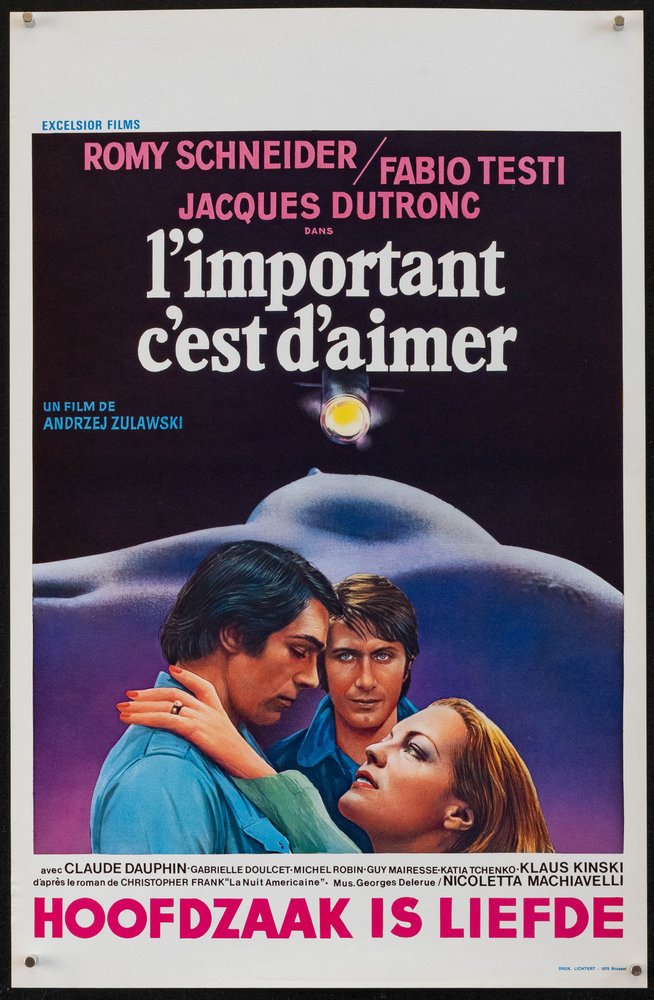
That Most Important Thing: Love

That Most Important Thing: Love (L'important c'est d'aimer)

Movie · 1975 · 15 people

Polish director Andrzej Żuławski made L'important c'est d'aimer (That Most Important Thing: Love), a French-Italian-West German romantic drama, in 1975. He co-adapted and directed it from Christopher Frank's novel La Nuit américaine, published on 1 December 1972, which has no connection with Truffaut's 1973 film of that name. The production company was Cineriz, and the running time is 109 minutes.

The story centres on Nadine Chevalier (Romy Schneider), a B-list actress in the violent, unforgiving world of French show business. The photographer Servais Mont (Fabio Testi) falls in love with her on a film set; since Nadine's husband is played by Jacques Dutronc, the three are caught in a tragic love triangle. Klaus Kinski, Claude Dauphin and Roger Blin take important supporting roles.

After his second film, The Devil, was banned in Poland, Żuławski moved to France and made this film there. With the popular Schneider and the singer Dutronc in the cast, it was such a success, with 1,544,986 admissions, that it allowed him to return to Poland. In 1976 Schneider received the first César Award for Best Actress for the role, and Pedro Almodóvar dedicated All About My Mother partly to her performance in it.

DirectorAndrzej Zulawski
Production companyCineriz

Reactions

You can pick up to 3 reactions.

Cast

Only cast members with a profile on this site are listed.

Jacques Boudet Jacques Boudet Actor · died at 89 Paul Bisciglia Actor · died at 81 Romy Schneider Jacques Dutronc Fabio Testi Klaus Kinski Claude Dauphin Roger Blin Katia Tchenko Andrée Tainsy Claude Legros Claudine Beccarie Éric Vasberg Gabrielle Doulcet Guy Delorme
Through different eyes

Cinephile Looks at script, editing and directing choices; keeps a distance from formula films.

The story's skeleton, a tragic triangle between an actress, her husband and the photographer who falls for her, leans on familiar melodrama patterns; the script itself offers few surprises. What lifts the film above that pattern is that it is built around Romy Schneider's performance. This role, which earned her the first César for Best Actress and to which Almodóvar partly dedicated All About My Mother, is the film's centre. Adapted from Christopher Frank's novel, it shows the film world as a merciless arena while speaking from inside it. In my view the film finds its true worth when judged as actors' cinema.

History & Society Lens Asks about the period, the social background and what the work reflects.

The film shows French show business through the eyes of a B-list actress, from the lower rungs of the system, which makes the tension between art and making a living visible. This is a story not of fame but of survival. The director's context matters too: having moved to France after his second film was banned in Poland, Żuławski depicts the harshness of an industry in which he was an outsider. That the film's large audience success made his return home possible is a small but striking example of how cinema moved between Eastern and Western Europe in the seventies.

Family Viewer Asks whether the whole household can watch it; cares about humour and heart.

Not a film for a family evening. It is a tragic love triangle set in an unforgiving industry, and a heavy drama aimed at adults. Too dark for children and for teenagers alike. For adult viewers who like intense, emotional drama. If you want a relaxed evening with the whole household, pick something else.

These are not reader reviews: they are short editorial takes written from different viewer perspectives with AI assistance. Reader reviews are below.

Reviews (0)

Log in Log in to write a review.

Comments