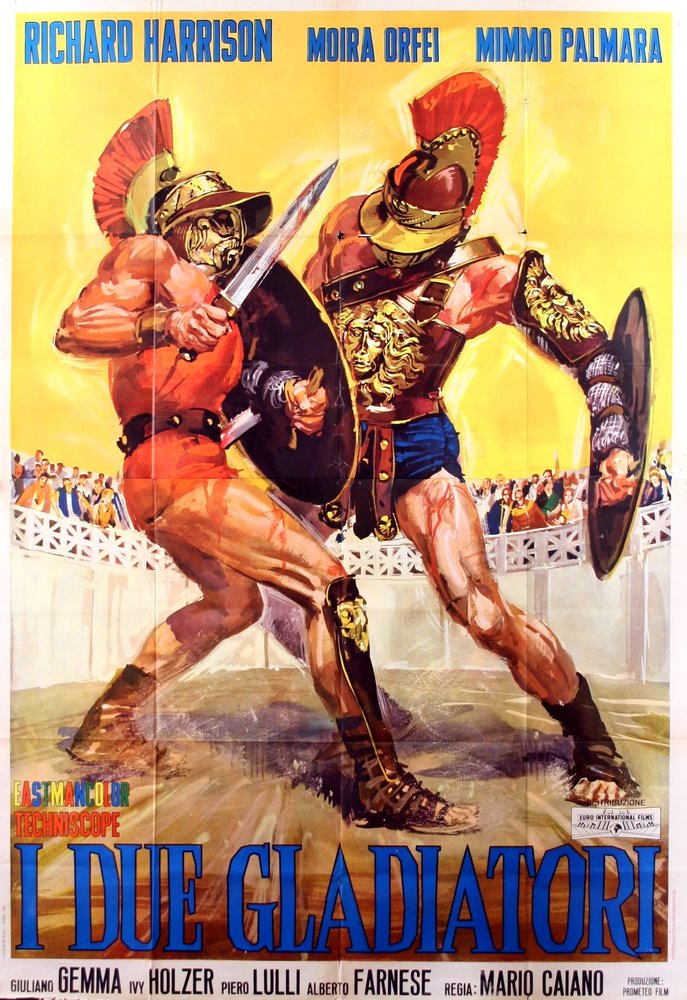
The Two Gladiators

The Two Gladiators (I due gladiatori)

Movie · 1964 · 15 people

Richard Harrison stars in The Two Gladiators (I due gladiatori), a sword-and-sandal picture that Mario Caiano directed in Italy in 1964. The film runs roughly an hour and a half. It is also known as Fight or Die, and was shown in France as La Fureur des gladiateurs and in Germany as Kaiser der Gladiatoren. Alfonso Brescia and Mario Amendola wrote the screenplay.

The story begins when the Roman emperor Marcus Aurelius fathers twin sons. To head off a succession crisis, one son is to be named heir and the other killed. The senator given the task cannot go through with it and secretly places the infant with a foster family. Years later Commodus takes the throne, and the senator tries to put forward the emperor's estranged twin, Lucius Crassus, as a rival claimant. The brothers soon scheme against each other, and the feud carries them into the gladiatorial arena. Besides Harrison, the cast includes Mimmo Palmara, Moira Orfei, Piero Lulli, Enzo Fiermonte, Mirko Ellis, Alberto Farnese, Giuliano Gemma and Nello Pazzafini.

The plot is largely fictional. It draws on the events of the Year of the Five Emperors, AD 193, that led to the death of Commodus and the proclamation of Pertinax as his successor.

DirectorMario Caiano

Reactions

You can pick up to 3 reactions.

Cast

Only cast members with a profile on this site are listed.

Richard Harrison Richard Harrison Film actor · 90 years old Nello Pazzafini Nello Pazzafini Actor · died at 62 Enzo Fiermonte Mirko Ellis Mimmo Palmara Moira Orfei Alberto Farnese Gianni Solaro Giuliano Gemma Ivy Holzer Piero Lulli Álvaro de Luna Renato Montalbano Adriano Micantoni Fortunato Arena

Through different eyes

Action & Thriller Fan Puts pace, tension and set pieces first; little patience for slow drama.

For sword-and-sandal fans the promise is clear: the brothers' feud ends up in the arena, which gives the story a firm target to build towards. But expecting today's fast fight choreography from a sixties Italian peplum is a recipe for disappointment. It suits viewers willing to wait patiently through palace scheming for the arena moments.

Cinephile Looks at script, editing and directing choices; keeps a distance from formula films.

The screenplay's most interesting choice is grafting a succession thriller onto peplum's usual muscle-and-arena template. The senator who spares the infant he was sent to kill is the story's moral engine, while the lost-twin device is a familiar trick of classic adventure fiction. In my view Mario Caiano chooses to run the formula neatly rather than renew it; the narrative calls in turn at every stop the genre's audience expects. The result does not push the genre's limits but sits tidily within them. Used more boldly, the twin motif could have made the brothers' turn against each other read as a conflict born of character rather than a requirement of the plot.

History & Society Lens Asks about the period, the social background and what the work reflects.

The film uses the real turmoil of AD 193, the Year of the Five Emperors, with the death of Commodus and the accession of Pertinax, as its backdrop, but Marcus Aurelius's secret twin son is pure invention. It is better seen not as a history lesson but as an example of how popular cinema dramatised Roman anxieties about succession. Dynasties seeking legitimacy through bloodline and a palace cut off from the people offered sixties audiences a familiar story about power. A good starting point for anyone curious about the period, though the real events deserve reading on their own.

These are not reader reviews: they are short editorial takes written from different viewer perspectives with AI assistance. Reader reviews are below.

Reviews (0)

Log in Log in to write a review.

Comments