Trop c'est trop

Trop c'est trop

Movie · 1975 · 15 people

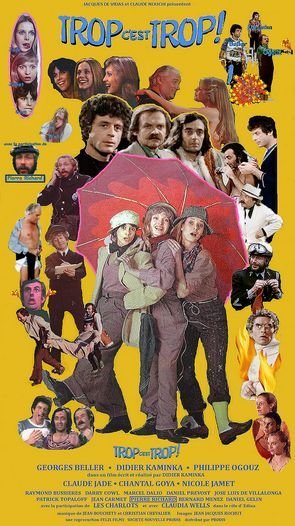
Didier Kaminka directed the French-language comedy Trop c'est trop ("Too Much Is Too Much") in 1975. The film runs about 95 minutes, and Kaminka is on screen as well as behind the camera, playing one of the three men at the centre of the story.

The story opens with three boys born on the same day, at the same hour and in the same room, just as the war was ending: Didier (Didier Kaminka), Philippe (Philippe Ogouz) and Georges (Georges Beller). At school all three court Edina (Claudia Wells), who was born at that very moment; she stays cold to the attention and does not hesitate to turn in anyone who goes too far. By the time they are thirty the friends have still not got what they wanted, and when Edina vanishes they set out to look for her. On the way they have to shake off three young women who have fallen for them, Patricia (Claude Jade), Carole (Chantal Goya) and Nicole (Nicole Jamet). They find Edina fending off the advances of a fashion photographer.

Beyond those names the cast includes Bernard Menez, Daniel Gélin, Jean Carmet, Marcel Dalio, Patrick Topaloff, Jacques Rouland, José Luis de Vilallonga and Darry Cowl.

DirectorDidier Kaminka

Reactions

You can pick up to 3 reactions.

Cast

Only cast members with a profile on this site are listed.

Darry Cowl Darry Cowl Stage actor · died at 80 Rufus Rufus Actor · 83 years old Bernard Menez Chantal Goya Claude Jade Claudia Wells Daniel Gélin Didier Kaminka Georges Beller Jacques Rouland Jean Carmet José Luis de Vilallonga Les Charlots Marcel Dalio Nicole Jamet

Through different eyes

Yeşilçam Nostalgic A viewer raised on the classics, looking for warm storytelling and strong acting.

The cast alone is an invitation for lovers of older French cinema: familiar faces such as Daniel Gélin, Jean Carmet and Marcel Dalio in one film. Three friends born on the same day, at the same hour, in the same room is a charming, fairy-tale opening, too. But a story built on years of chasing a girl who shows no interest in them turns, over time, from sweet innocence into tiresome insistence. For anyone looking for the grace and warmth of the classic comedies, it may feel a little slight.

Cinephile Looks at script, editing and directing choices; keeps a distance from formula films.

Kaminka appearing both behind the camera and on screen as one of the three leads gives the film the feel of a personal comedy. Structurally it combines a life chronicle with a search comedy: a story that opens at birth, passes through school and turns into a hunt once the men are in their thirties. That long time span is ambitious, but squeezed into about 95 minutes, each stage in my view ends up as short as a sketch and the characters never get the chance to deepen. What emerges is a scattered but likeable comedy whose premise is more appealing than its construction.

History & Society Lens Asks about the period, the social background and what the work reflects.

That the three heroes are born just as the war is ending is a small but telling detail: in 1975, when the postwar generation was reaching its thirties, the film turns that generation's men, struggling to settle into adult life, into comedy. Its relationships with women openly reflect the attitudes of the time. Edina's indifference is drawn as an obstacle to overcome, while the women who fall for the heroes are treated as burdens to shake off. Seen from today, it is a small but instructive example of how 1970s French comedy approached gender roles.

These are not reader reviews: they are short editorial takes written from different viewer perspectives with AI assistance. Reader reviews are below.

Reviews (0)

Log in Log in to write a review.

Comments