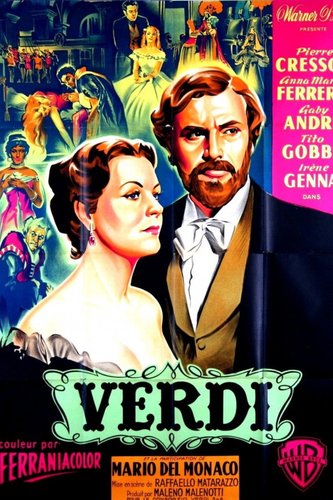
Giuseppe Verdi

Giuseppe Verdi

Movie · 1953 · 15 people

Raffaello Matarazzo directed Verdi, released in Italy as Giuseppe Verdi, a color film from 1953. It tells a romanticized life story of the Italian opera giant Giuseppe Verdi (1813-1901), concentrating on his adult years. In the United States it played in cinemas as The Life and Music of Giuseppe Verdi and reached video as Verdi, the King of Melody. Its manner is that of the tear-jerking melodrama, aiming to move the audience to tears.

The composer is played by the French actor Pierre Cressoy. Anna Maria Ferrero, Gaby André and Laura Gore take the main female roles, and Camillo Pilotto, Emilio Cigoli, Loris Gizzi, Irene Genna, Mario Ferrari and Enrico Glori also appear in the cast. The story weaves Verdi's private life together with the turning points of his musical career. Well-known figures of the era, Alexandre Dumas fils and Victor Hugo, appear as characters, with Guido Celano playing Hugo.

Leonardo Benvenuti, Mario Monicelli and Piero Pierotti wrote the screenplay. The film was a hit with Italian audiences of its time and grossed more than 957 million lire at the box office.

DirectorRaffaello Matarazzo

Reactions

You can pick up to 3 reactions.

Cast

Names without a link have no profile here yet.

Guido Celano Guido Celano Actor · died at 83 Victor Hugo Pierre Cressoy Anna Maria Ferrero Gaby André Irene Genna Laura Gore Camillo Pilotto Emilio Cigoli Loris Gizzi Mario Del Monaco Tito Gobbi Aldo Bufi Landi Franca Dominici Mario Ferrari Enrico Glori

Through different eyes

AI-assisted editorial takes written from different viewer perspectives. They are not reader reviews; those are below.

Cinephile Looks at script, editing and directing choices; keeps a distance from formula films.

The film makes no secret of its intent: it is built as a melodrama designed to move the audience to tears. For a biopic, that is both a strength and a weakness. Having Leonardo Benvenuti, Mario Monicelli and Piero Pierotti on the screenplay is notable, yet the result is a romanticised narrative that chooses to exalt Verdi rather than understand him. Weaving private life together with career milestones is dramatically shrewd, but over a long running time the pattern risks turning repetitive. Bringing Victor Hugo and Alexandre Dumas fils on as characters also hints at a tendency to parade the era's luminaries past the camera. Shooting in color was an ambitious choice for 1953. Worthwhile for devotees of the genre; too sugary for anyone wanting a detached, probing biography.

History & Society Lens Asks about the period, the social background and what the work reflects.

The film portrays Giuseppe Verdi (1813-1901), one of the towering figures of 19th-century Italian culture, through his adult years. The appearance of Victor Hugo and Alexandre Dumas fils as characters is a reminder of how intertwined Europe's artistic world was at the time. A caution is in order, though: this is a romanticized life story, not a history book. Melodrama's rules put emotional effect ahead of the actual course of events, so it is best not to take historical details from this film. That it drew large Italian audiences and grossed more than 957 million lire is telling in itself: it can be read as a society's wish to celebrate a national genius through an emotional story.

Reviews (0)

Log in Log in to write a review.

Comments