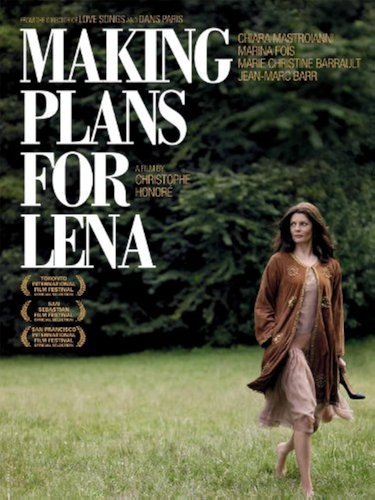
Making Plans for Lena (Non ma fille tu n'iras pas danser)

Making Plans for Lena (Non ma fille tu n'iras pas danser)

Movie · 2009 · 11 people

Christophe Honoré directed the 2009 French comedy-drama Making Plans for Lena, known in French as Non ma fille, tu n'iras pas danser. Marketed as a tragicomic family drama, it follows his earlier successes Aşk Şarkıları and Güzel İnsan (their Turkish release titles). Honoré wrote the screenplay with Geneviève Brisac, whose novel Week-end de chasse à la mère inspired it, and Why Not Productions produced. Running about 105 minutes, it opened in France on September 2, 2009.

At its center is Léna, a free-spirited woman who has been fighting to keep afloat with her two children since leaving her husband Nigel. She bravely overcomes the obstacles in her path, but her real test is a well-meaning, boundless family determined to make her happy at any cost. Caught between her insistent mother, her gravely ill father, her moody sister, her indifferent brother and her ex-husband, Léna feels betrayed and wants only to rebel and be herself. Chiara Mastroianni plays Léna, Marina Foïs is Frédérique, Marie-Christine Barrault is Annie and Jean-Marc Barr is Nigel; Louis Garrel and Caroline Silhol are also in the cast.

DirectorChristophe Honoré
Production companyWhy Not Productions

Reactions

You can pick up to 3 reactions.

Cast

Names without a link have no profile here yet.

Jean-Marc Barr Jean-Marc Barr Actor · 66 years old Nigel Alice Butaud Caroline Silhol Chiara Mastroianni Fred Ulysse Julien Honoré Louis Garrel Marcial Di Fonzo Bo Marie-Christine Barrault Marina Foïs Esther Garrel

Through different eyes

AI-assisted editorial takes written from different viewer perspectives. They are not reader reviews; those are below.

Cinephile Looks at script, editing and directing choices; keeps a distance from formula films.

Following Love Songs and The Beautiful Person, Christophe Honoré turns to a tragicomic family drama and takes on the genre's hardest job: carrying pain and absurdity in the same scene. The film's most interesting idea is to set against its heroine not someone malicious but a well-meaning family bent on making her happy, so the conflict grows out of love itself. In that sense the screenplay, co-written with Geneviève Brisac, offers a clever inversion. But that is also where the risk lies: a crowd that can be summed up in one adjective each, the insistent mother, the ailing father, the moody sister, the indifferent brother, threatens to shrink characters into types. When the tonal balance slips, tragicomedy can end up in a middle zone that neither fully amuses nor truly moves.

Family Viewer Asks whether the whole household can watch it; cares about humor and heart.

A film about how much a big family can meddle in someone's life, even out of love. It deals with separation, serious illness and family resentments, so it may be both dull and heavy for young children. For adults and older teens, it is a good chance to talk about where good intentions turn into pressure. Watched together with grandparents, it could spark some interesting conversations.

History & Society Lens Asks about the period, the social background and what the work reflects.

Léna's story centers on a woman struggling to stay afloat with her two children after leaving her husband, tested by her family's loving but boundless attention. That is an intriguing form of modern family control: the pressure comes not from prohibitions but from plans made for your own good. Nor is it foreign to Turkish viewers; elders stepping into a divorced woman's life is familiar in many homes. In that sense the film shows how long the family's weight on the individual persists even in a society that prizes individuality. Its focus on emotional relationships rather than adding class or economic depth does, however, limit that reading.

Reviews (0)

Log in Log in to write a review.

Comments