Peppermint Soda

Peppermint Soda (Diabolo menthe)

Movie · 1977 · 15 people

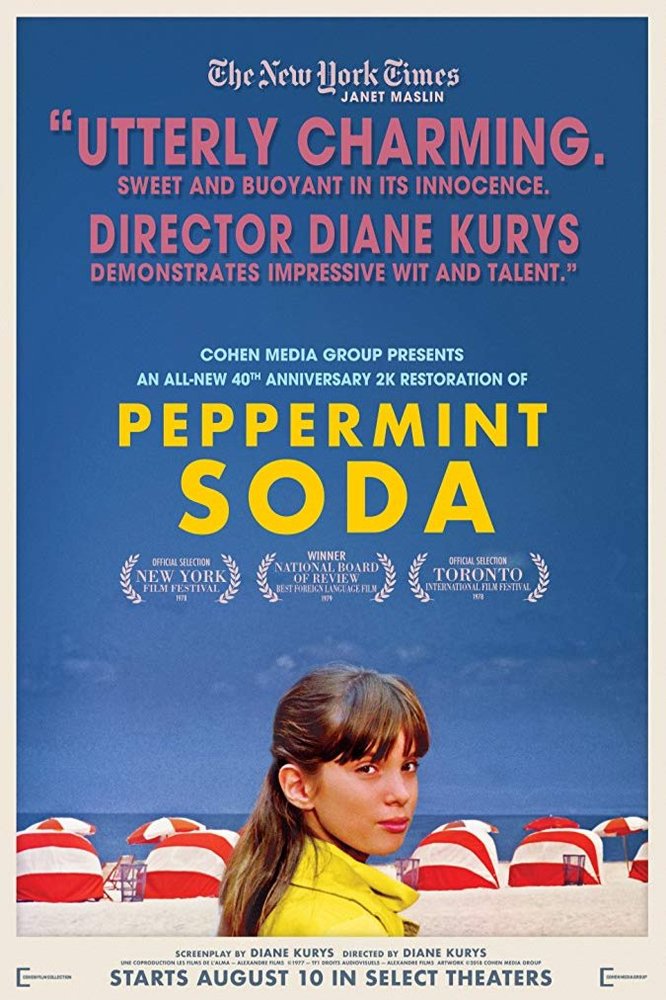
Diane Kurys wrote and directed her debut film, Peppermint Soda, a 1977 French comedy-drama about growing up, known at home as Diabolo menthe. Counted as a teen film and lasting roughly 101 minutes, it took the Louis Delluc Prize in its year of release. The story is partly drawn from the director's own experiences, and the film opens with a dedication to the director's sister, who "still hasn't given back my orange sweater".

The story follows two teenage sisters through 1963 and 1964. The girls live with their mother in a single-parent household and attend the Lycée Jules-Ferry in Paris. The title alludes to a grown-up fizzy drink that the younger sister orders in a café. The cast includes Éléonore Klarwein, Odile Michel, Anouk Ferjac, Dominique Lavanant, Dora Doll and Claude Confortès.

Kurys made several films loosely inspired by her parents' lives, seen through the eyes of herself and her older sister. In story order they run: Coup de foudre (1983) covers her parents' meeting, Pour une femme (2013) the first years of their marriage and La Baule-les-Pins (1990) their separation. Diabolo menthe concentrates on the two sisters and their mother as a one-parent family.

DirectorDiane Kurys

Reactions

You can pick up to 3 reactions.

Cast

Only cast members with a profile on this site are listed.

Tsilla Chelton Actor · died at 93 Yves Rénier Yves Rénier Film actor · died at 78 Éléonore Klarwein Odile Michel Anouk Ferjac Arlette Bonnard Claude Confortès Coralie Clément Corinne Dacla Denise Péron Dominique Lavanant Dora Doll Françoise Bertin Jacqueline Doyen Jacques Rispal
Through different eyes

Cinephile Looks at script, editing and directing choices; keeps a distance from formula films.

For a debut, this is a surprisingly assured piece of work. Drawing on her own experience gives Kurys the kind of small, precise details an invented coming-of-age story cannot supply; even the opening dedication about the orange sweater sets the tone at once: light, wry and affectionate. It is a structure built on observation rather than big events. That is also its weakness: viewers looking for a strong dramatic spine may find it too loose and small in scale. Seen alongside the other films Kurys drew from her family, though, this modest start gains extra value as the doorway to a wider autobiographical cycle.

History & Society Lens Asks about the period, the social background and what the work reflects.

The film portrays Paris in 1963-64 through two sisters and the mother raising them alone, which already sets it outside the usual family picture of the time. The daily life and rules of a girls' lycée, and the young people's eagerness to taste the grown-up world, open a small but valuable window on France just before the great social upheavals of the late sixties. It matters too that a woman director drew the story from her own youth: the girls' experience is told in their own voice rather than as the object of an outsider's gaze.

Family Viewer Asks whether the whole household can watch it; cares about humour and heart.

A nice choice to watch with teenage daughters; it gets you talking about sisterhood, the bond between a mother and her girls, and the growing pains in between. The story is about everyday life rather than big events, so young children may get bored. Better suited to teenagers watching with their parents and grandparents.

These are not reader reviews: they are short editorial takes written from different viewer perspectives with AI assistance. Reader reviews are below.

Reviews (0)

Log in Log in to write a review.

Comments