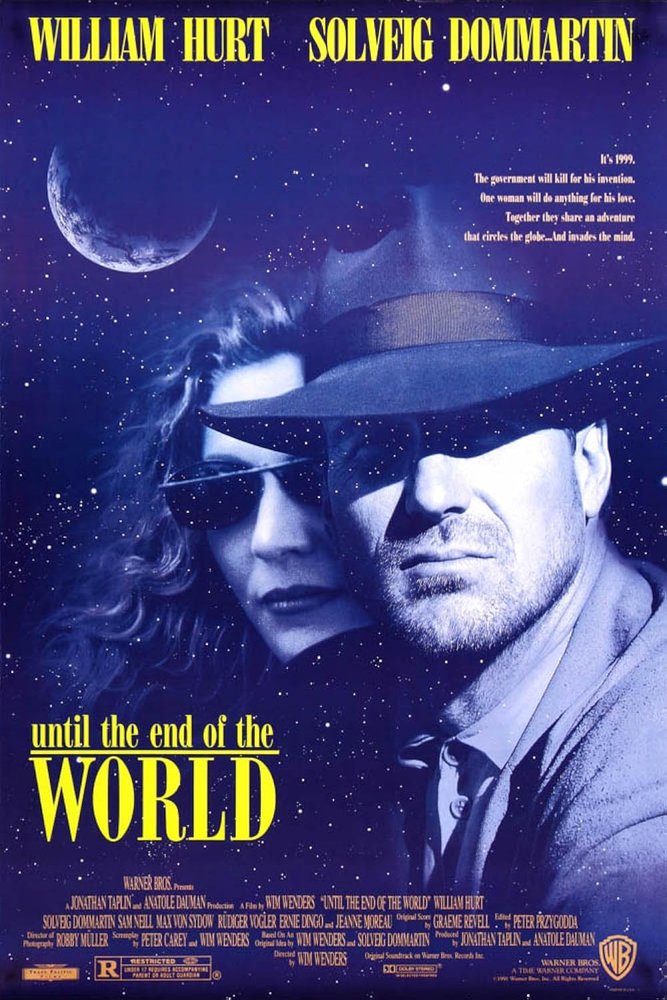
Until the End of the World

Until the End of the World (Bis ans Ende der Welt)

Movie · 1991 · 15 people

Wim Wenders directed Until the End of the World (Bis ans Ende der Welt in German, Jusqu'au bout du monde in French) in 1991, an epic science fiction drama. A co-production of France, Germany and Australia, it is spoken in English, French and German and carries post-apocalyptic and cyberpunk elements. Wenders was known for the road movie and conceived this as the ultimate example of the genre.

The story unfolds at the turn of the millennium, in the shadow of a world-changing catastrophe. A man and a woman are pursued across the globe because of a device that can record visual experiences and make dreams visible. Solveig Dommartin plays Claire Tourneur, and William Hurt plays Sam Farber, a character also known as Trevor McPhee. The cast includes Sam Neill, Max von Sydow, Rüdiger Vogler, Ernie Dingo and Eddy Mitchell as Raymond Monnet, along with Jeanne Moreau, Maurice Ronet and Stéphane Audran.

An initial draft of the script was written by the American filmmaker Michael Almereyda. The final screenplay is credited to Wenders and the Australian novelist Peter Carey, from a story by Wenders and Dommartin. Made on a budget of about 23 million dollars, it opened in Germany on September 12, 1991. It was released in several versions running from 158 to 287 minutes.

DirectorWim Wenders
Production companyWarner Bros.

Reactions

You can pick up to 3 reactions.

Cast

Only cast members with a profile on this site are listed.

Jeanne Moreau Jeanne Moreau Film actor · died at 89 Eddy Mitchell Eddy Mitchell Television actor · 84 years old William Hurt Solveig Dommartin Sam Neill Max von Sydow Rüdiger Vogler Jean Seberg Maurice Ronet Stéphane Audran Ernie Dingo Lois Chiles Chick Ortega Amália Rodrigues Dolores Chaplin

Through different eyes

Cinephile Looks at script, editing and directing choices; keeps a distance from formula films.

Wenders's ambition to make the ultimate road movie is both the film's strength and its weakness. A structure that stretches across the globe takes the genre's sense of drifting and searching to an enormous scale, and a device that makes dreams visible is a rich cinematic metaphor for the link between image and memory. Yet gathering so many countries, characters and genre elements scatters the narrative; science fiction, chase and love story cannot all be held at the same weight. The existence of cuts of very different lengths also suggests a project that kept reshaping itself rather than one definitive film. It rewards patient viewers who can take that sprawl as exploration.

History & Society Lens Asks about the period, the social background and what the work reflects.

A 1991 film imagining the turn of the millennium is a time capsule in its own right. Fear of catastrophe sitting side by side with fascination for technology captures the uncertainty of the early nineties well. A device that records visual experience and makes dreams visible can be read as an intuition about our relationship with our own images, and given how we live with screens today it looks remarkably far-sighted. The French, German and Australian co-production and its three spoken languages also support a vision of a world where borders blur. The film hints at these ideas more than it argues them, but what it hints at still feels current.

Action & Thriller Fan Puts pace, tension and set pieces first; little patience for slow drama.

A pursuit across the globe, an air of catastrophe and cyberpunk touches look like a perfect thriller recipe on paper. But here the chase is a means, not the point; the film cares about the rhythm of travel and thought more than thrills. If you expect a fast sci-fi thriller, it will test your patience. Give it a go only if you are ready to sink into atmosphere instead of set pieces.

These are not reader reviews: they are short editorial takes written from different viewer perspectives with AI assistance. Reader reviews are below.

Reviews (0)

Log in Log in to write a review.

Comments