Acı Hatıralar

Painful Memories (Acı Hatıralar) (translated)

Movie · 1977 · 3 people

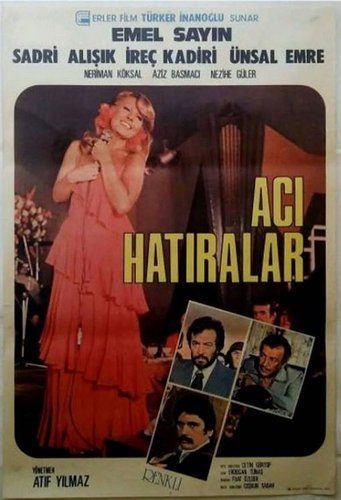
Acı Hatıralar ("Bitter Memories") is a 1977 Turkish-Iranian co-production in colour, mixing drama, musical and romance. Atıf Yılmaz directed it together with the Iranian actor-director İreç Kadiri (Iraj Ghaderi). Erler Film made it, with Gençzade and Türker İnanoğlu producing and Fuat Özlüer and Erdoğan Tünaş writing. It opened on February 1, 1977, runs about 97 minutes and was shot in Turkey and Iran.

The story begins in a nightclub. Emel (Emel Sayın), who sings backing vocals for the club owner Osman (Sadri Alışık), one day sings alone and wins great applause. Among the customers is Kemal (İreç Kadiri), who is secretly a smuggler. Osman offers Emel the soloist's spot, and she and Kemal fall in love and start planning a wedding. Kemal's man Mahmut (Ünsal Emre) claims heroin has turned up among the goods and sends Kemal off to Tehran. Kemal leaves a letter explaining everything, but Mahmut hides the letters. Emel becomes a star, and the story, moving between Istanbul and Tehran, runs through misunderstandings, a prison sentence and years apart.

The music is by Coşkun Sabah and the photography by Çetin Gürtop. Neriman Köksal and Aziz Basmacı are also in the cast. It is a Turkish- and Persian-language production.

DirectorAtıf Yılmaz, İreç Kadiri
Production companyErler Film

Reactions

You can pick up to 3 reactions.

Cast

Through different eyes

Yeşilçam Nostalgic A viewer raised on the classics, looking for warm storytelling and strong acting.

Emel Sayın's voice and Sadri Alışık's presence are an invitation in themselves for anyone fond of the musical melodramas of the seventies. A singer's story that begins in a nightclub and rises to stardom is a pattern Yeşilçam was devoted to, and Coşkun Sabah's music adds a colour that suits it well. Separation, hidden letters and years of longing are ingredients that always knew how to bring the old audience to tears. The intrusion of smuggling and heroin casts a slight shadow over the genre's warmth, but the real heart of this film beats in its songs.

History & Society Lens Asks about the period, the social background and what the work reflects.

Being a Turkish-Iranian co-production shot in 1977 makes the film historically interesting: filmmakers from the two countries bring Istanbul and Tehran together in one story and use Turkish and Persian side by side. The link between the nightclub, singing and smuggling gives a sense of how the entertainment world of the period's big cities was pictured on screen. Emel's rise from backing vocals to soloist also prompts thought about women performers' struggle to be seen on stage. Looked at today, the film can also be read as a trace of a time when filmmakers from two neighbouring countries worked together.

Cinephile Looks at script, editing and directing choices; keeps a distance from formula films.

Atıf Yılmaz sharing the director's chair with İreç Kadiri reflects the co-production's attempt to bring two film traditions together. The script, however, leans on melodrama's most worn-out mechanisms, hidden letters and misunderstandings, and events are driven less by the characters' choices than by a henchman's interference. That suits the period's fast production habits but makes for a dramatically passive structure: the leads undergo what happens to them rather than shaping the story. On the other hand, Çetin Gürtop's photography and shooting in two countries can give it a wider sense of place than many films of its day. The musical numbers are what really carry the rhythm.

These are not reader reviews: they are short editorial takes written from different viewer perspectives with AI assistance. Reader reviews are below.

Reviews (0)

Log in Log in to write a review.

Comments