Child of Sorrows (Acıların Çocuğu)

Child of Sorrows (Acıların Çocuğu) (translated)

Movie · 1985 · 10 people

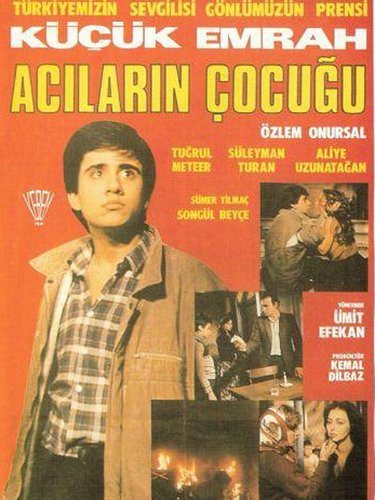
The 1985 Turkish film Acıların Çocuğu ("Child of Sorrows") follows the melodramatic vein of arabesk and drama. It was directed by Ümit Efekan from a screenplay by Erdoğan Tünaş and produced by Şahin Dilbaz for Kerem Film. Shot in color on 35 mm, it runs 91 minutes. The lead is Emrah, a familiar face of the era's arabesk melodramas, in a role bearing his own name.

The story begins when a father who has gambled away his wife's and children's livelihood takes his own life out of guilt. His widow Elvan (Özlem Onursal), pushed by a friend as well, ends up in the sex trade in order to feed her three children. The younger ones are small, but Emrah knows what is going on; he cannot accept his mother's earnings and leaves home for a family that takes him in. One night when Elvan is away, a fire reduces the house to ashes. Believing her children dead, she loses her mind and is hospitalized, although no bodies were ever found. Emrah keeps struggling against poverty.

The cast also includes Tuğrul Meteer as Kemal, Süleyman Turan as Emrah's father, Aliye Uzunatağan as Songül and Sümer Tilmaç as Yusuf. Kenan Kurt shot the film and Uğur Bayar is credited for the music.

DirectorÜmit Efekan
Production companyKerem Film

Reactions

You can pick up to 3 reactions.

Cast

Also in the cast: Emrah, Küçük Emrah
Through different eyes

Yeşilçam Nostalgic A viewer raised on the classics, looking for warm storytelling and strong acting.

Every vein of the 1980s arabesk melodrama runs through this film: a family wrecked by gambling, poverty, a child torn from his mother, and that merciless wheel called fate. Giving Emrah a role under his own name openly counts on the bond audiences of the time had with that familiar face. The moral center of the old Yeşilçam family dramas is in place too; a boy who refuses his mother's earnings is a hero straight out of that tradition. Yet the sorrows pile up so relentlessly that the story at times has no room to breathe. The feeling is genuine, but it plays like a lament that has lost all sense of measure.

History & Society Lens Asks about the period, the social background and what the work reflects.

The film tells the story of 1980s poverty in the language of arabesk. Gambling debts, suicide, a widow left desperate by the struggle to make ends meet, and a boy who leaves home: nearly every social wound of the era is loaded onto a single family. The boy's inability to accept the money once he knows how his mother earns it says a lot about how decisive notions of honor and shame were in those years. Arabesk cinema deserves to be taken seriously because it voiced the anger and grief of people on society's margins. Despite its excess, this film can be read as a period document of how that grief was put on screen.

Family Viewer Asks whether the whole household can watch it; cares about humor and heart.

Not suitable for watching with children. It deals with very heavy subjects: a father's suicide, a mother pushed into the sex trade, a house fire and a psychiatric hospital. There is a child at the center of the story, but this is not a children's film. Adults curious about 1980s arabesk cinema may find it interesting; if you watch it with teenagers, be sure to talk it through afterwards.

These are not reader reviews: they are short editorial takes written from different viewer perspectives with AI assistance. Reader reviews are below.

Reviews (0)

Log in Log in to write a review.

Comments