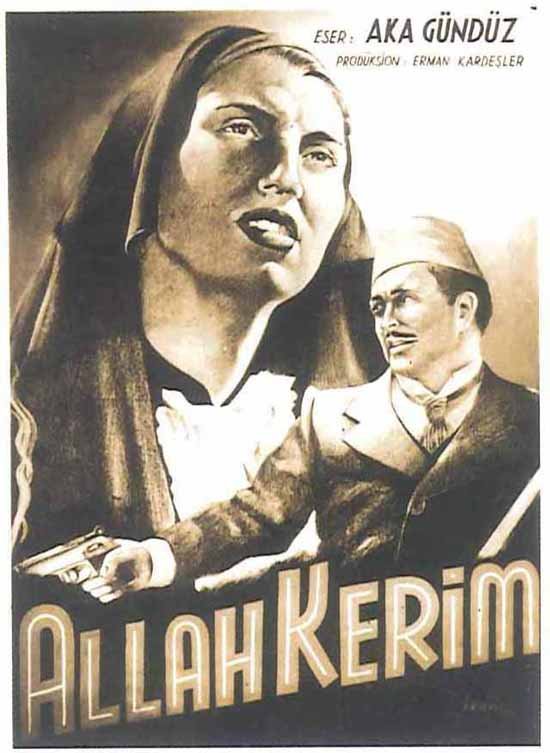
Allah Kerim

God Is Generous (Allah Kerim) (translated)

Movie · 1950 · 6 people

Semih Evin directed Allah Kerim, a black-and-white Turkish period drama from 1950, and also adapted the screenplay from the novel of the same name by Aka Gündüz. Produced by Hürrem Erman for Erman Film, the picture features a score composed by Sadettin Kaynak and cinematography by Yoakim Filmerides, and runs about 101 minutes.

Set in the final years of the reign of Sultan Abdul Hamid II, the story follows Ayşesin, the daughter of a pasha opposed to the sultan, and her fiancé Kerim Bey. While travelling from Istanbul to Adapazarı on a hunting trip, the couple are shadowed on suspicion of belonging to a secret organisation. During a ride, men working for Fettah, a gendarmerie commander loyal to the regime, ambush the party and try to abduct Ayşesin; she drives them off with her pistol and shoots the horse of Fettah, who is hiding in the bushes. Humiliated in front of his men, Fettah sets in motion a ruthless plan of revenge. A notable scene brings Ayşesin face to face with Abdul Hamid II himself at Yıldız Palace.

Sezer Sezin stars as Ayşesin, opposite Kenan Artun as Kerim and Orhon Murat Arıburnu as Fettah, while Vedat Örfi Bengü portrays Abdul Hamid II. The cast also includes Settar Körmükçü, Arşavir Alyanak and Muazzez Arçay, and future director Atıf Yılmaz served as assistant director on the production.

DirectorSemih Evin
Production companyErman Film

Reactions

You can pick up to 3 reactions.

Cast

Vedat Örfi Bengü Vedat Örfi Bengü Actor · died at 53 II. Abdülhamit Sezer Sezin Kenan Artun Orhon Murat Arıburnu Arşavir Alyanak Muazzez Arçay
Through different eyes

Yeşilçam Nostalgic A viewer raised on the classics, looking for warm storytelling and strong acting.

Allah Kerim is a precious keepsake from the early years of Turkish cinema. Being adapted from Aka Gündüz's novel and scored by Sadettin Kaynak makes it doubly valuable for lovers of literature and Turkish classical music. Drawing Ayşesin as a young woman who will not bow, who drives off her attackers with her own pistol, is a heartening act of courage for the cinema of those years. And the fact that Atıf Yılmaz, later a great master, passed through this set as assistant director is a lovely footnote for anyone fond of our film history.

History & Society Lens Asks about the period, the social background and what the work reflects.

The film portrays the last years of Abdul Hamid II's reign through the way suspicion and surveillance hem in everyday life. That an opposition pasha's daughter and her fiancé are shadowed merely on suspicion of belonging to a secret organisation gives a strong impression of the political climate of a period often remembered as one of autocracy. Ayşesin's encounter with the sultan at Yıldız Palace is also notable for placing a real historical figure inside a melodrama. But in a 1950 novel adaptation, one should allow for the sultan and the regime's men being drawn through the common historical outlook of that time; the film is not a history lesson but a reading of a novel.

Cinephile Looks at script, editing and directing choices; keeps a distance from formula films.

In script terms, Allah Kerim runs on a classic melodrama engine: a villain humiliated in front of his men and his plan for revenge. The device sets the story moving quickly, but it also risks locking the characters into clear-cut lines of good and evil; to the extent that Fettah's motive amounts to no more than a personal insult, his villainy reads as a requirement of the plot rather than dramatic depth. Semih Evin's attempt to hold a novel, an ambush in the countryside and a palace scene face to face with the sultan within one frame is an ambitious choice for 1950. An instructive example for anyone studying the narrative language of early Turkish cinema.

These are not reader reviews: they are short editorial takes written from different viewer perspectives with AI assistance. Reader reviews are below.

Reviews (0)

Log in Log in to write a review.

Comments