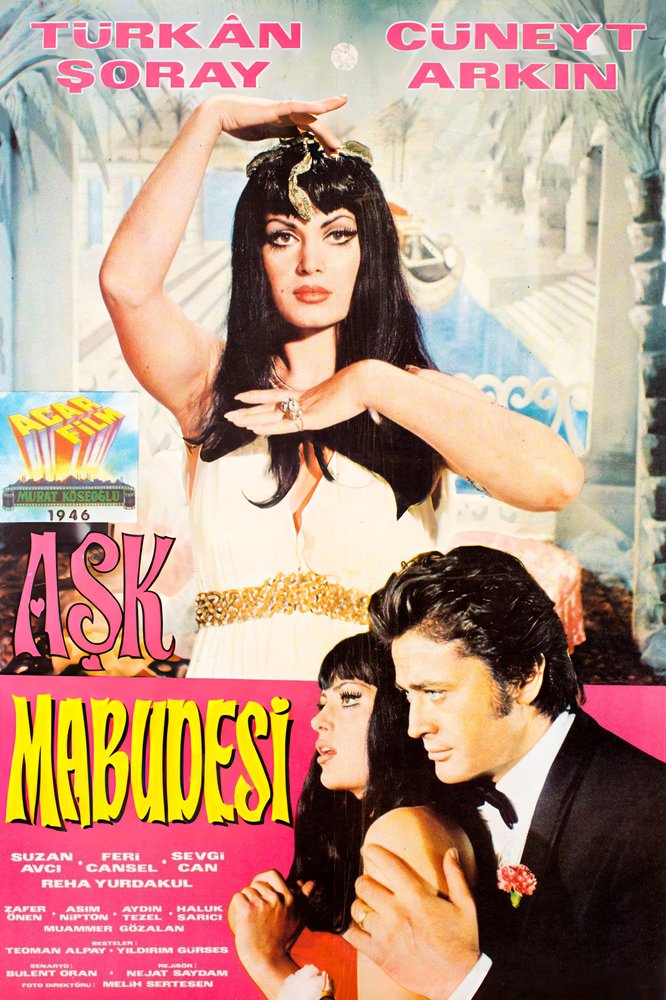
Goddess of Love (Aşk Mabudesi)

Goddess of Love (Aşk Mabudesi) (translated)

Movie · 1969 · 10 people

Nejat Saydam directed Aşk Mabudesi (Goddess of Love), a Turkish colour melodrama from 1969, written with Bülent Oran and starring Türkân Şoray opposite Cüneyt Arkın.

At its heart is Leyla, a poor young woman who lost both parents and must fend for herself. After a brawl costs her the fortune-telling job she held at an amusement park, singer Suzan helps her into a nightclub, where she progresses from selling peanuts to performing as the lead vocalist. Ekrem, a famous writer of romance novels, is engaged to a wealthy society girl he does not love. While scouting nightlife as material for his next book, he encounters Leyla, who wins his affection and inspires his novel's heroine. He ends the engagement, determined to marry her, but the jealousy of his ex-fiancée Jale, a doctored suicide letter, and a car accident that blinds Ekrem drive the lovers apart. Leyla rises to stardom as a singer under the name Ayla Gül, while Ekrem donates his wealth and falls into poverty. Their devotion survives every trial, and a successful eye operation finally allows them to reunite.

DirectorNejat Saydam
Production companyAcar Film

Reactions

You can pick up to 3 reactions.

Cast

Through different eyes

Yeşilçam Nostalgic A viewer raised on the classics, looking for warm storytelling and strong acting.

Aşk Mabudesi gathers all the beloved ingredients of Yeşilçam melodrama: an orphaned but dignified young woman, a love that deepens with every trial, a style that brings tears and hope into the same scene. Seeing Türkân Şoray and Cüneyt Arkın in one story is a memento of an era in itself. Leyla's rise as a singer also gives the film a musical warmth. Today's audiences may find it too sentimental, but that sentiment is the soul of those films; few productions now portray, with such sincerity, a world where love is held above money and pride.

Cinephile Looks at script, editing and directing choices; keeps a distance from formula films.

The script, co-written with Bülent Oran, turns every gear of the genre in order: a jealous ex-fiancée, a doctored suicide letter, an accident that blinds the hero. These devices are legitimate under the melodrama contract of the day, but looking back it is obvious that events are driven more by coincidence than by the characters' choices. In return, the opposing movement between Leyla's rise as a singer and Ekrem giving away his fortune and sinking into poverty is the structure's most elegant idea; running the two paths in opposite directions builds a dramatic symmetry. Enjoyable melodrama for those who accept the formula; for a critical eye, far too predictable.

History & Society Lens Asks about the period, the social background and what the work reflects.

The film openly carries the class fantasies of late-sixties Turkish melodrama. The path of a poor young woman who has lost both parents, from fortune-teller at an amusement park to peanut seller at a nightclub and then lead vocalist, shows which doors urban economic life left open to women's work. On the other side, a loveless engagement to a society girl and a fortune given away by choice build a familiar morality in which wealth is cold and loveless and poverty dignified. That outlook may seem a little fairy-tale today, but it is a good document of the hopes audiences of the time held on to.

These are not reader reviews: they are short editorial takes written from different viewer perspectives with AI assistance. Reader reviews are below.

Reviews (0)

Log in Log in to write a review.

Comments