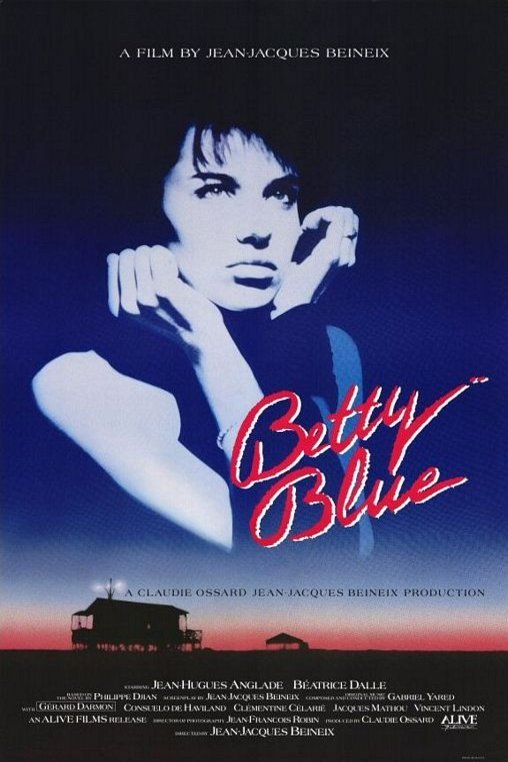
Betty Blue

Betty Blue (37°2 le matin)

Movie · 1986 · 15 people

Jean-Jacques Beineix wrote and directed Betty Blue, whose original title, 37°2 le matin ("37.2° in the Morning"), refers to the normal waking body temperature of a pregnant woman. Adapted from Philippe Djian's novel of the previous year, the 1986 French erotic psychological drama was the eighth highest-grossing film of that year in France and is often placed within the Cinéma du Look movement.

The story begins with Zorg (Jean-Hugues Anglade), who works in beachside bungalows and writes in his spare time, living a quiet, orderly life. That order is upended when the free-spirited, unpredictable Betty (Béatrice Dalle) comes into it. Her successive crises drive her into severe mental breakdown, and the couple's love swings between devotion and destruction. Gérard Darmon, Jacques Mathou, Vincent Lindon and Dominique Pinon also appear.

It played in cinemas in a markedly shortened cut; in 1991 Beineix released a director's cut running 63 minutes longer. In 1987 it was nominated for both the Academy Award and the BAFTA for Best Foreign Language Film, and it also drew a Golden Globe nomination and five César nominations. It won a César for its poster design and an award at the 1992 Seattle International Film Festival.

DirectorJean-Jacques Beineix
Production companyGaumont Yapımevi

Reactions

You can pick up to 3 reactions.

Cast

Only cast members with a profile on this site are listed.

Vincent Lindon Vincent Lindon Actor · 67 years old Jacques Mathou Jacques Mathou Actor Jean-Hugues Anglade Béatrice Dalle Dominique Pinon Gérard Darmon Consuelo de Haviland Clémentine Célarié Claude Aufaure Dominique Besnehard Raoul Billerey Claude Confortès André Julien Philippe Laudenbach Franck-Olivier Bonnet

Through different eyes

Cinephile Looks at script, editing and directing choices; keeps a distance from formula films.

Betty Blue bears the signature of the Cinéma du Look: image, colour and atmosphere matter as much as the events of the story. Beineix's adaptation rests on the contrast between Zorg's calm routine and Betty's volatility, and that tension drives the film. There is a structural problem, though: because the story is built from Zorg's world, Betty risks remaining an object of observation rather than a character, her inner life always relayed from the outside. That the film was released in a noticeably shortened cut and later followed by a much longer director's cut is also an important detail: which version you watch can seriously change its rhythm and the depth of its characters.

History & Society Lens Asks about the period, the social background and what the work reflects.

Betty Blue is the story of two people living on the edge of the system in 1980s France: Zorg works on beach bungalows and tries to write in his spare time, while Betty fits into no order at all. The film captures the tension between artistic dreams and everyday survival well. Seen from today, its most contested aspect is how it portrays mental collapse: as Betty's crises are presented as part of a grand passion, the question of romanticising mental illness arises. Still, its place among the most-watched films in France that year shows it touched the mood of a generation trying to stay outside the system.

Family Viewer Asks whether the whole household can watch it; cares about humour and heart.

This is not a film to watch with the family. It is known as an erotic drama and depicts a severe mental breakdown; with both its sexual content and its heavy themes, it is not suitable for children or teenagers. Even adult viewers may find it draining. If you are looking for something the whole household can watch, choose something else; save this one for adults after the kids are asleep.

These are not reader reviews: they are short editorial takes written from different viewer perspectives with AI assistance. Reader reviews are below.

Reviews (0)

Log in Log in to write a review.

Comments