Cici Damat

Le gendarme se marie

Movie · 1968 · 3 people

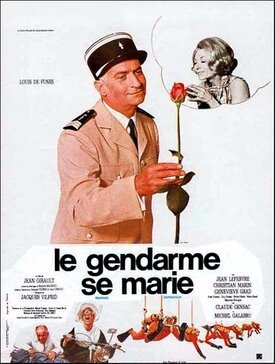
Jean Girault directed Cici Damat, known in France as Le Gendarme se marie (roughly "The Gendarme Gets Married"), a French-Italian comedy from 1968. It is the third of six films about the gendarmes of Saint-Tropez. The series began in 1964 and continued in 1965 with Le Gendarme à New York, and three more films came after this one. It opened in France and Italy on 30 August 1968 and drew 6.8 million viewers in France, though critics said the star left his partners little room.

Louis de Funès is once again the Saint-Tropez gendarme Ludovic Cruchot. This time Cruchot grows close to Josépha, the widow of a gendarmerie colonel. She expects great things of him, which causes friction with his superior Gerber (Michel Galabru). Claude Gensac joins the series as Josépha and becomes de Funès's permanent screen wife. Geneviève Grad plays Cruchot's daughter Nicole for the last time. The station crew has Jean Lefebvre, Christian Marin and the duo Grosso and Modo. The script lets de Funès try romantic comedy while keeping his character as acid as ever.

Jacques Vilfrid, Girault and Richard Balducci wrote the screenplay and Raymond Lefèvre composed the music. Société Nouvelle de Cinématographie and Medusa Film produced it. Shooting took place around Saint-Tropez and at the Billancourt studios, and a long strike after the events of May 1968 disrupted the work.

DirectorJean Girault
Production companySociété Nouvelle de Cinématographie

Reactions

You can pick up to 3 reactions.

Cast

Only cast members with a profile on this site are listed.

Through different eyes

Yeşilçam Nostalgic A viewer raised on the classics, looking for warm storytelling and strong acting.

Louis de Funès's Cruchot is the most endearing face of those Saint-Tropez films that settled into memory under their Turkish titles. In this third outing the gendarme's heart turns to Josépha, a colonel's widow, and Claude Gensac's arrival brings fresh warmth to the series. Raymond Lefèvre's music rounds off the light, cheerful mood. True, de Funès's energy is so dominant that, as critics said at the time, his partners are left little room to breathe. Even so, comedies that make you laugh without turning crude carry a grace that is missed today.

Family Viewer Asks whether the whole household can watch it; cares about humour and heart.

A comedy everyone from grandparents to kids can laugh at. Louis de Funès's faces and fluster will get even children giggling. The humour comes mostly from the chaos at the station and Cruchot's romantic flap, and the tone is light overall. The only catch is that Cruchot's sharp tongue and nonstop rushing about may wear some viewers out. A good pick for a family weekend.

Cinephile Looks at script, editing and directing choices; keeps a distance from formula films.

In the series' third film Jean Girault tries a new colour without really breaking the formula: the script gives de Funès room to try romantic comedy while sharpening the character's crankiness further. Claude Gensac's Josépha is a smart move in that respect, giving Cruchot a partner who can answer his fluster. Yet the film is built entirely as a star vehicle. The station crew of Jean Lefebvre, Christian Marin, Grosso and Modo mostly becomes a set of figures keeping time with de Funès's rhythm, and the critics' objection back then still holds. Its 6.8 million admissions in France prove the formula works, but in terms of film language it offers no step forward.

These are not reader reviews: they are short editorial takes written from different viewer perspectives with AI assistance. Reader reviews are below.

Reviews (0)

Log in Log in to write a review.

Comments