Dialogue with the Carmelites

Dialogue with the Carmelites (Le Dialogue des carmélites)

Movie · 1960 · 6 people

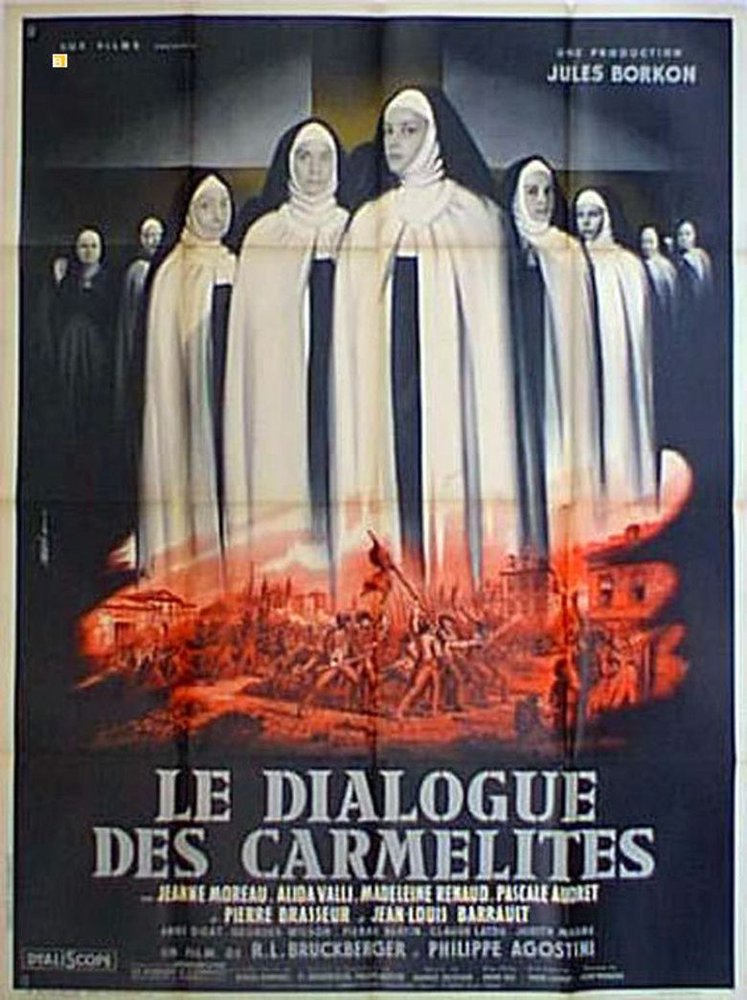
Dialogue with the Carmelites (French: Le Dialogue des carmélites; Italian: I dialoghi delle Carmelitane) is a historical drama set during the French Revolution and made as a French-Italian co-production. Released in 1960, it runs about 112 minutes and was directed jointly by Philippe Agostini, a former cinematographer, and the priest Raymond Léopold Bruckberger. Shot in French, it is also known as The Carmelites and, in Germany, as Opfergang einer Nonne.

It tells of the Martyrs of Compiègne, the Carmelite nuns guillotined in Paris in 1794 in the last days of the Terror. Their convent had been closed and they were arrested, and they would not give up their vocation. The film brings out the fear, resolve and shared faith of the women as they wait for trial and execution. Jeanne Moreau, Alida Valli, Madeleine Renaud, Pascale Audret, Pierre Brasseur and Jean-Louis Barrault lead the cast, with Georges Wilson, Judith Magre and Pierre Bertin among the other players.

The screenplay is built on Georges Bernanos's dialogues. Bernanos's work in turn grew out of Gertrud von Le Fort's 1931 novel, which itself drew on the notes of Sister Marie de l'Incarnation, a nun who survived.

DirectorPhilippe Agostini, Raymond Léopold Bruckberger

Reactions

You can pick up to 3 reactions.

Cast

Only cast members with a profile on this site are listed.

Through different eyes

History & Society Lens Asks about the period, the social background and what the work reflects.

The film rests on the true story of the Carmelite nuns of Compiègne, guillotined in Paris in 1794 in the last days of the French Revolution's Reign of Terror. The tension between the Revolution's promise of liberty and its pressure on religious institutions takes concrete form in a closed convent and the arrest of its women. The film's sympathies plainly lie with the nuns, yet its real interest is less in politics than in the fear and shared resolve of women who refuse to renounce their vocation. That Bernanos's dialogues grew from a novel based on the notes of a surviving nun adds intriguing layers between history and fiction. A worthwhile period film for anyone thinking about what revolutions cost individuals.

Cinephile Looks at script, editing and directing choices; keeps a distance from formula films.

Co-direction by a former cinematographer and a priest sums up the film's character: Philippe Agostini's visual precision sits beside Bruckberger's spiritual concerns. A cast uniting Jeanne Moreau, Alida Valli, Madeleine Renaud and Jean-Louis Barrault is an acting masterclass in itself. The script, built on Bernanos's dialogues, is both its strength and its weakness: dense, reflective exchanges about fear and faith weigh scenes down, and at times it feels more like a staged text than cinema. At around 112 minutes it can feel long at this intensity. Even so, its focus on the shared resolve of women awaiting trial and execution is thematically coherent and affecting.

Action & Thriller Fan Puts pace, tension and set pieces first; little patience for slow drama.

The subject is real and deeply dramatic: nuns arrested during the Terror and waiting for trial. But the film builds that tension through long, heavy dialogue rather than action. For nearly two hours it is mostly conversations and inner struggles. The pressure does build, but getting there takes patience. A tough watch if you want pace; better suited to fans of classic drama.

These are not reader reviews: they are short editorial takes written from different viewer perspectives with AI assistance. Reader reviews are below.

Reviews (0)

Log in Log in to write a review.

Comments