The Oldest Profession

The Oldest Profession (Le Plus Vieux Métier du monde)

Movie · 1967 · 6 people

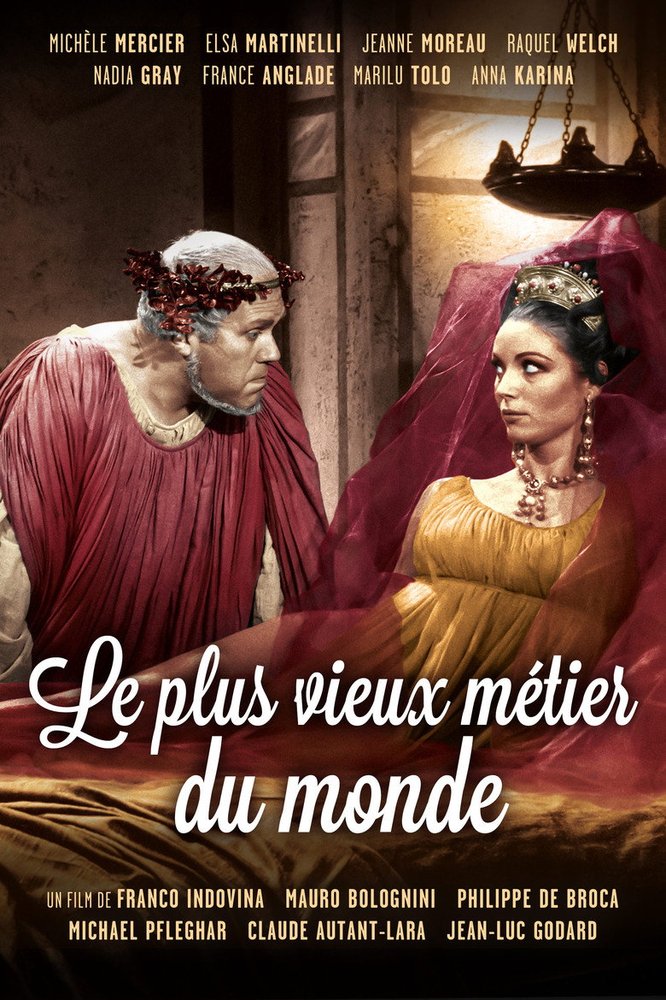
France, Italy and West Germany co-produced The Oldest Profession (French: Le Plus Vieux Métier du monde), a sketch film from 1967. This comedy about prostitution through the ages is an anthology in which six directors each made a segment: Claude Autant-Lara, Philippe de Broca, Jean-Luc Godard, Mauro Bolognini, Franco Indovina and Michael Pfleghar. It was shot in French and runs about 120 minutes. In Spain it played as El oficio más viejo del mundo and in Argentina as El amor a través del tiempo.

The six sketches are presented in the manner of a "mondo" documentary and stretch from prehistory to the year 2000, which was then the future. The film thus gathers the profession across different ages under a comic umbrella. The international cast includes Jeanne Moreau, Jean-Claude Brialy, Michèle Mercier, Elsa Martinelli, Enrico Maria Salerno, Gabriele Tinti, Gastone Moschin, Nadia Gray, Marcel Dalio, Jacques Charrier, Anna Karina and Raquel Welch.

Jean Aurenche, Daniel Boulanger and Ennio Flaiano worked on the screenplay. Horst Wendlandt produced the film and Michel Legrand composed the music.

DirectorJean-Luc Godard, Claude Autant-Lara

Reactions

You can pick up to 3 reactions.

Cast

Only cast members with a profile on this site are listed.

Through different eyes

Cinephile Looks at script, editing and directing choices; keeps a distance from formula films.

An anthology in which six directors each take one sketch on the same subject across the ages is an inviting playground on paper. Seeing Claude Autant-Lara's classical tradition and Godard's restless modernism meet in a single film is intriguing in itself. But the familiar problem of portmanteau films shows here too: tone and rhythm vary a great deal from segment to segment, so don't expect a unified narrative. The framing borrowed from "mondo" documentaries is a clever device for stitching the sketches together; still, at around two hours, some segments may feel longer than they need to be. Michel Legrand's music and names like Jeanne Moreau and Anna Karina are reason enough for anyone curious about the European cinema of the period.

History & Society Lens Asks about the period, the social background and what the work reflects.

In tracing prostitution from prehistory to the year 2000, the film also records how 1960s Europe saw its own time and the future. As a co-production between France, Italy and West Germany, it reflects the co-production culture of European cinema in those years. Treating the subject as comedy is a deliberate choice, but it risks pushing the heavier sides of the trade, such as exploitation and poverty, into the background. For today's viewer, the most interesting part may be seeing how the year 2000, still the future back then, was imagined.

Family Viewer Asks whether the whole household can watch it; cares about humour and heart.

This film is about prostitution, and even though it is a comedy, it is not one to watch with children. It is made of six separate sketches, so each part has a different feel. It also runs about two hours. Adults who enjoy older European films may find it interesting. But for a family evening with grandparents and kids, it is better to pick something else.

These are not reader reviews: they are short editorial takes written from different viewer perspectives with AI assistance. Reader reviews are below.

Reviews (0)

Log in Log in to write a review.

Comments