Flight from Ashiya

Flight from Ashiya

Movie · 1964 · 8 people

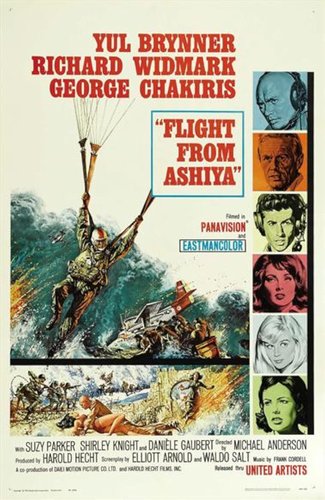
Adventure, drama and romance mix in Flight from Ashiya, a 1964 American-Japanese military adventure film directed by Michael Anderson. It centres on the U.S. Air Force's Air Rescue Service and the flights it runs from Ashiya Air Base in Japan. The film is based on Elliott Arnold's 1956 novel Rescue!, which was reprinted in 1959 as Flight from Ashiya. In Japan it is known as Ashiya Kara no hiko, in French as Les Trois Soldats de l'aventure, and in Brazil as Sacrifício sem Glória.

Set in the early 1960s, the story gives a flight crew the job of rescuing Japanese civilians stranded on a liferaft in rough seas. Yul Brynner, Richard Widmark and George Chakiris lead the cast, with Suzy Parker and Shirley Knight among the other prominent names; Danielle Gaubert, Andrew Hughes and William Ross are also listed.

Waldo Salt wrote the screenplay, Harold Hecht produced, and Frank Cordell composed the music. The English-language film runs about 102 minutes and lists Kadokawa Pictures as its production company. Making it took nearly two years. Most of the shooting took place at the U.S. Air Force air squadron's base in Tachikawa, and the squadron supplied two twin-engine Grumman HU-16 Albatross amphibious aircraft for the production.

DirectorMichael Anderson
Production companyKadokawa Pictures

Reactions

You can pick up to 3 reactions.

Cast

Only cast members with a profile on this site are listed.

Andrew Hughes Actor · 1908 – 1996 Yul Brynner Richard Widmark George Chakiris Suzy Parker Shirley Knight Danièle Gaubert William Ross

Through different eyes

Action & Thriller Fan Puts pace, tension and set pieces first; little patience for slow drama.

A rescue flight, rough seas and civilians stranded on a liferaft: on paper, that set-up could carry tension from start to finish, and shooting with real U.S. Air Force aircraft is an advantage that gives the scenes weight. But for anyone used to today's pace, this is no race-against-the-clock rescue film. The adventure takes turns with drama and romance, and the momentum dips whenever the emotional side takes over.

History & Society Lens Asks about the period, the social background and what the work reflects.

Made as an American-Japanese co-production roughly two decades after the war ended, the film is an interesting period document in its own right. At its centre are crews flying from a U.S. base in Japan to rescue Japanese civilians, so the relationship between the two countries is framed through aid and cooperation rather than hostility. It is a useful example of how the American military presence in early-1960s Japan wanted to be seen on screen. Still, a frame like this easily risks leaving the Japanese side as nothing more than the people being rescued, and the film is best watched with that question in mind.

Cinephile Looks at script, editing and directing choices; keeps a distance from formula films.

The material from Elliott Arnold's novel tries to fuse adventure, drama and romance into one. That blend, common in large-scale productions of the 1960s, yields a rich texture when handled well and a narrative that cannot find its direction when handled carelessly. A three-headed star line-up of Brynner, Widmark and Chakiris also makes it unavoidable to ask where the story's centre of gravity lies; in casts like this, the script often trades dramatic intensity for giving everyone room. The film sits more fairly when judged not as a personal directorial vision but as a careful, professional genre product of its time.

These are not reader reviews: they are short editorial takes written from different viewer perspectives with AI assistance. Reader reviews are below.

Reviews (0)

Log in Log in to write a review.

Comments