I Love You All

I Love You All (Je vous aime)

Movie · 1980 · 10 people

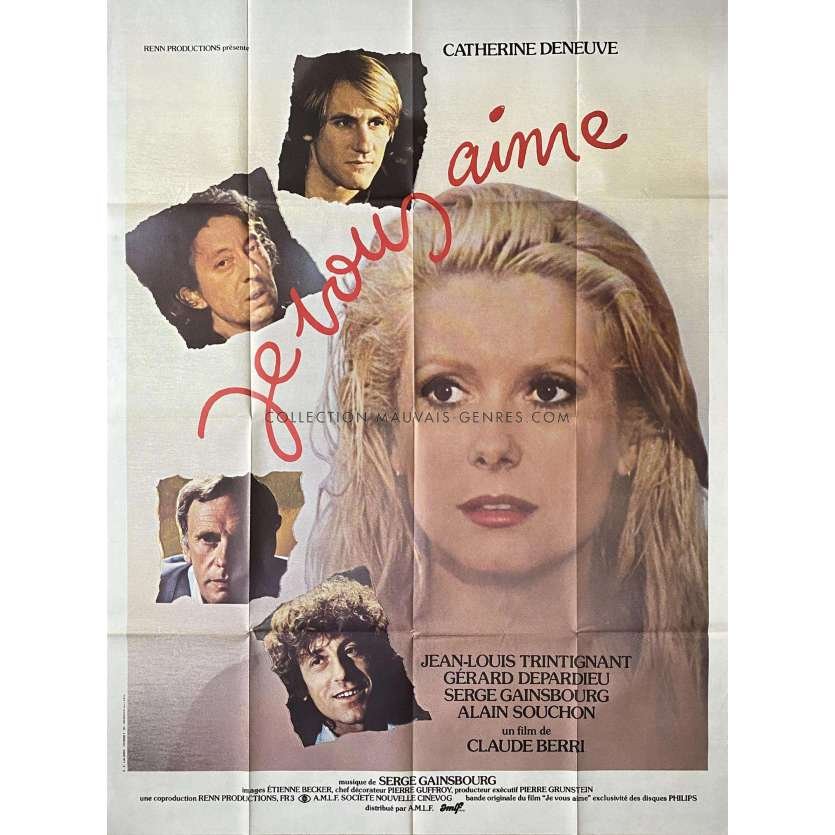
Claude Berri directed the 1980 French film Je vous aime, known in English as I Love You All, which is classed as a drama and a romance. Berri wrote the screenplay with Michel Grisolia. Claude Berri and Pierre Grunstein produced it, and it was made under the Renn Productions banner. It runs 105 minutes. The film opened in France on 17 December 1980 and reached American audiences in 1981. In Germany it is known as Die Männer, die ich liebte.

The story centres on Alice, a thirty-five-year-old songwriter with a career, children and lovers. For her, love is loveliest at the very start, in the brief moments when everything looks perfect. As a relationship goes on she tires of it, suffers, makes others suffer, and starts over. On a Christmas evening spent with her new partner Julien, Alice thinks back over the intense moments and the months she shared with former lovers, two of whom are there that night.

Catherine Deneuve plays Alice. Jean-Louis Trintignant, Gérard Depardieu, Serge Gainsbourg and Alain Souchon are also in the cast, and Christian Marquand, Dominique Besnehard, Thomas Langmann and Gaëtan Bloom are named among the players. Gainsbourg composed the music.

DirectorClaude Berri
Production companyRenn Productions

Reactions

You can pick up to 3 reactions.

Cast

Only cast members with a profile on this site are listed.

Catherine Deneuve Catherine Deneuve Film actor · 83 years old Jean-Louis Trintignant Jean-Louis Trintignant Character Actor · died at 91 Gérard Depardieu Serge Gainsbourg Alain Souchon Christian Marquand Dominique Besnehard Thomas Langmann Gaëtan Bloom Ysabelle Lacamp

Through different eyes

Cinephile Looks at script, editing and directing choices; keeps a distance from formula films.

Claude Berri's film is built on Alice recalling her past relationships on a Christmas evening, and that framing device brings both function and problems. The present-day evening is an elegant mechanism that gathers the flashbacks into one moment, and having two former lovers in the room creates natural tension between memory and the present. On the other hand, as the story cyclically repeats the idea that love is loveliest at the very start, dramatic progression weakens and the relationships risk feeling like variations on one another. Facing Deneuve with Trintignant, Depardieu and Gainsbourg gives the cast real weight, and Gainsbourg's score is what carries the film's wistful mood.

History & Society Lens Asks about the period, the social background and what the work reflects.

The film paints an interesting portrait of women's independence in early-1980s France. Alice has a career, children and lovers; the story does not confine her to the role of wife or mother. A heroine who believes love is loveliest at the beginning and starts over when a relationship tires her opens up the shifting gender roles of the time and the price of freedom. The film neither judges that choice nor glorifies it: Alice suffers and makes others suffer. That balanced view keeps it worth debating despite all the years since.

Family Viewer Asks whether the whole household can watch it; cares about humour and heart.

This is not a family film. It is about an adult woman's past loves and relationships; there is nothing in it for children, and it will not say much to teenagers either. It is a quiet romantic drama that moves mostly through conversation. Adults who enjoy French cinema and relationship stories are better off watching it among themselves.

These are not reader reviews: they are short editorial takes written from different viewer perspectives with AI assistance. Reader reviews are below.

Reviews (0)

Log in Log in to write a review.

Comments