India Song

India Song

Movie · 1975 · 14 people

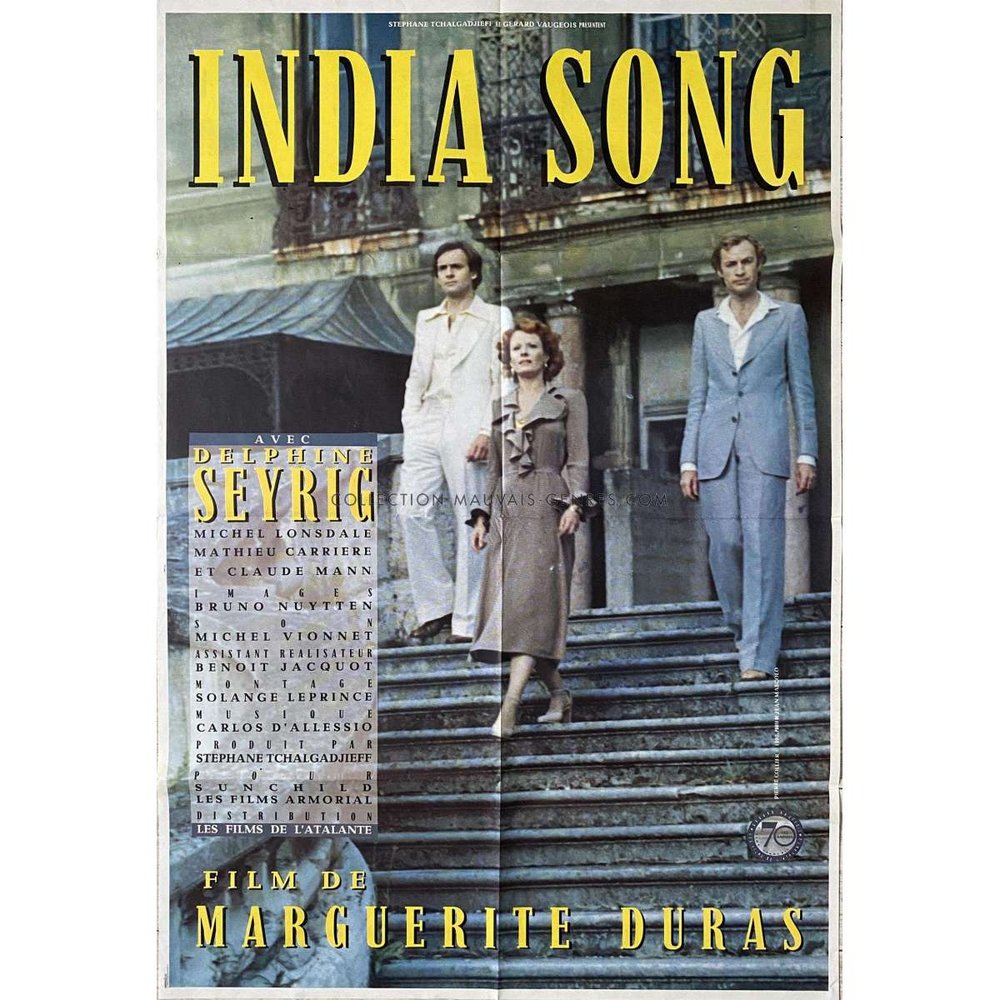
Marguerite Duras wrote and directed the French drama India Song in 1975. It belongs to her "Indian Cycle" and is known for its formal daring: Duras deliberately separates what she calls the "film of the voices" from the "film of the images", and no character's words are matched by lip movement. It also appears on the list 1001 Movies You Must See Before You Die.

The story takes place in 1930s Calcutta during the monsoon season. At its centre is Anne-Marie Stretter, the enigmatic, disillusioned wife of the French ambassador, played by Delphine Seyrig. Bored with a stifling life, she seeks relief in affairs, while her husband knows and looks the other way. The cast includes Michael Lonsdale, Mathieu Carrière, Vernon Dobtcheff, Didier Flamand and Claude Mann, who plays Michael Richardson.

Although the story is set in India, the film was mainly shot at the Château Rothschild in France. It is adapted from Duras's 1973 play of the same name, which was inspired by her 1966 novel Le Vice-Consul. It won the prize of the French art-house cinema association and was France's entry for Best Foreign Language Film at the 48th Academy Awards, without a nomination. It runs about two hours, and a 1976 sequel, Her Venetian Name in Deserted Calcutta, followed.

DirectorMarguerite Duras

Reactions

You can pick up to 3 reactions.

Cast

Only cast members with a profile on this site are listed.

Delphine Seyrig Delphine Seyrig Actor · died at 58 Michael Lonsdale Michael Lonsdale Actor · died at 89 Mathieu Carrière Vernon Dobtcheff Didier Flamand Benoît Jacquot Claude Mann Daniel Dobbels Françoise Lebrun Jean-Claude Biette Marguerite Duras Nicole Hiss Pascal Kané Viviane Forrester

Through different eyes

Cinephile Looks at script, editing and directing choices; keeps a distance from formula films.

India Song's real subject may be cinema itself. By building sound and image as two separate films, Duras breaks the usual identification with characters: there are no speaking lips, and the voices seem to come from the past or from another room. That split carries perfectly the presence of Anne-Marie Stretter, who seems at once there and long gone, and lends the character a ghostly quality. The method has a price, though: the static shots and repetitive rhythm can turn airless over the course of the film and leave out viewers who want anything from the narrative. As an act of formal daring it is an important experiment, but it is a film that demands patience and is not easily loved.

History & Society Lens Asks about the period, the social background and what the work reflects.

The film is set in 1930s Calcutta yet shows almost nothing of India; even its being shot at a château in France is, I think, part of that gaze. The world of the colonial elite is pictured as closed, stifling and turned in on itself within the embassy walls. An ambassador's wife who seeks refuge from boredom in affairs during the monsoon heat, and a husband who looks the other way, stand for the moral and emotional exhaustion of a privileged class. The absence of the local population reads not as an omission but as a statement: colonial rule can carry on without ever seeing the country it governs.

Family Viewer Asks whether the whole household can watch it; cares about humour and heart.

Not a film for the family. Its subject is a married woman's affairs. On top of that it moves very slowly, and the voices are not matched to the characters' lips, which will bore children and teenagers almost at once. It is for adults interested in art films, to watch alone on a quiet evening.

These are not reader reviews: they are short editorial takes written from different viewer perspectives with AI assistance. Reader reviews are below.

Reviews (0)

Log in Log in to write a review.

Comments