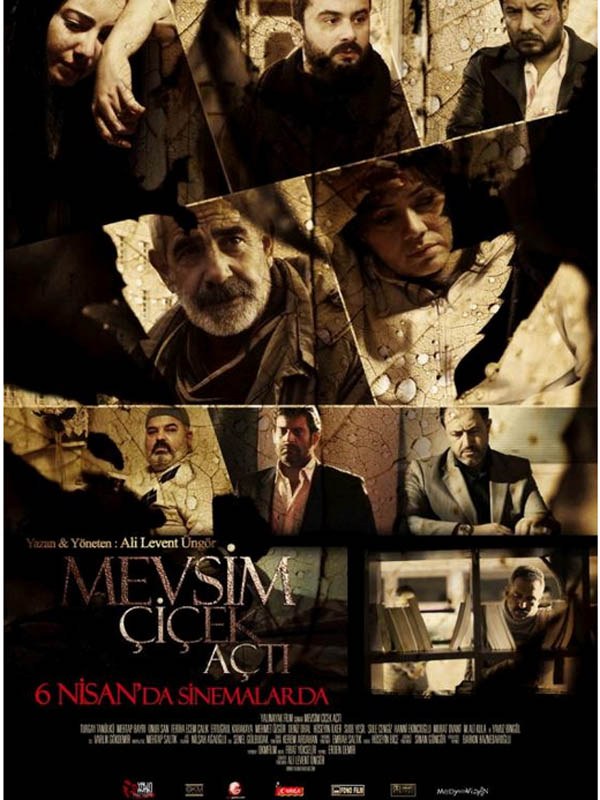
The Season Has Blossomed (Mevsim Çiçek Açtı)

The Season Has Blossomed (Mevsim Çiçek Açtı) (translated)

Movie · 2012 · 16 people

Set among immigrants in Germany, the 2012 Turkish drama Mevsim Çiçek Açtı deals with violence against women and the friendship of two women rebuilding their lives under the state's protection. A. Levent Üngör wrote the screenplay and also directed. Produced by Erden Demir, the film carries the Yalınayak Film name and was distributed by Medyavizyon. Shooting began in November 2011, and the film opened on April 6, 2012, and runs 110 minutes.

The story revolves around Nazmi, his wife Çiçek and their young daughter Mevsim, who live in Germany. After Nazmi repeatedly beats his wife, the state takes Çiçek and Mevsim under its protection and places them in an institution. There Çiçek meets Esra, the two become close friends and decide to move into a home together. While they rebuild their lives, a ride in Asaf's taxi gives their lives an unexpected turn. Çiçek is played by Feriha Ecem Çalık, Esra by Mehtap Bayrı, Asaf by Onur Şan and Musa by Turgay Tanülkü.

Behind the camera, Sinan Güngör handled cinematography, Fırat Yükselir composed the music, Hüseyin Biçe edited and Kerem Ardahan served as art director. Immigrant life, state protection and solidarity among women are central themes.

DirectorA. Levent Üngör
Production companyYalınayak Film
The Season Has Blossomed (Mevsim Çiçek Açtı) The Season Has Blossomed (Mevsim Çiçek Açtı) The Season Has Blossomed (Mevsim Çiçek Açtı)

Reactions

You can pick up to 3 reactions.

Cast

Kerem Alışık Kerem Alışık Actor · 66 years old Mehmet Özgür Mehmet Özgür Actor · 56 years old Ecem Çalık Ecem Çalık Actor · 37 years old Onur Şan Asaf Mehtap Bayri Esra Turgay Tanülkü Turgay Tanülkü Actor · 73 years old Musa Deniz Oral Deniz Oral Actor · 63 years old Ertuğrul Karakaya Mehmet özgür köksel Hüseyin İlker sude yesil Sule cengiz Hanni ekincioglu Mehmet Ali Kula Murat Ovant Yavuz Bingöl Yavuz Bingöl Singer · 62 years old

Through different eyes

History & Society Lens Asks about the period, the social background and what the work reflects.

The film tackles violence against women through an immigrant family in Germany and doesn't leave it as a purely domestic drama: the state's protection system carries the story. Çiçek and her daughter being placed in an institution, and the friendship formed there with Esra, stress that escaping violence takes not just individual courage but institutional support and solidarity among women. The loneliness of immigrant life sits alongside the fragility of a new life built under protection. The importance of the subject is beyond question, and part of the film's value lies in its effort to put the issue on the agenda.

Cinephile Looks at script, editing and directing choices; keeps a distance from formula films.

Written and directed by A. Levent Üngör, this is an issue film with a clear cause. The test for such films is keeping the message from crowding out the characters. The narrative has a solid backbone in the escape from violence and two women building a new life together, but letting a ride in Asaf's taxi turn the story hinges the dramatic shift on chance, a choice close to melodrama. Done well, such a turn creates a sense of fate; done hastily, it suggests the script took the easy way out. Best for viewers who respect the weight of the subject but aren't expecting formal innovation.

Family Viewer Asks whether the whole household can watch it; cares about humor and heart.

The film is about a woman repeatedly beaten by her husband, and a young girl is part of the story. Because of this heavy theme it is not suitable for small children. Watched with teenagers, though, it can be a meaningful chance to talk about violence and solidarity. An important subject for adults.

These are not reader reviews: they are short editorial takes written from different viewer perspectives with AI assistance. Reader reviews are below.

Reviews (0)

Log in Log in to write a review.

Comments