Ward 72 (72. Koğuş)

Ward 72 (72. Koğuş) (translated)

Movie · 2011 · 18 people

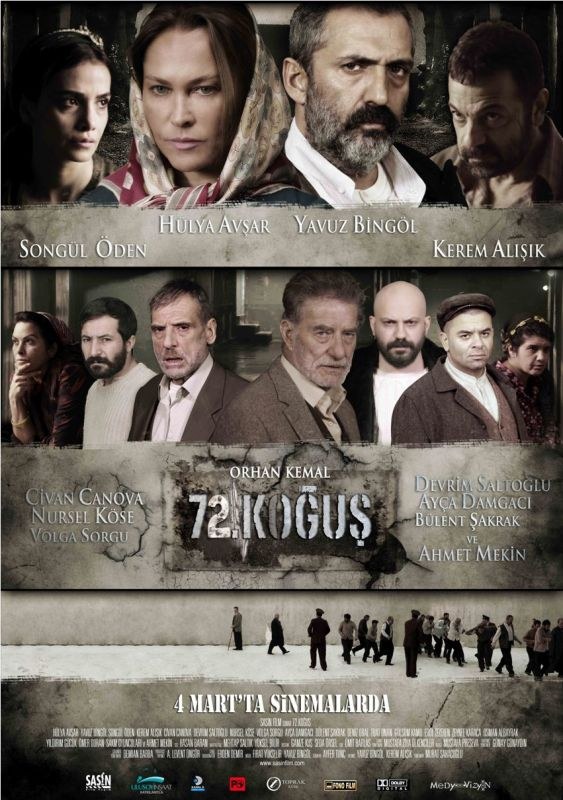
72. Koğuş (Ward 72) is a Turkish drama adapted from Orhan Kemal's novel of the same name. It opened on March 4, 2011, and runs about an hour and thirty-seven minutes. The novel draws on the author's impressions of Bursa Prison, where he served time in 1940; it is regarded as a cornerstone of Turkish literature and has a strong life on the theater stage. The film recounts life in a prison ward during a dark period when the Second World War loomed over Turkey.

At the center is Ahmet Kaptan, an honest and naive man. The ward is an ecosystem of its own, run by its own moral code. Shut in behind four walls, the inmates' relationships, suffering, dreams and contradictions are shown alongside their search for a place in a world that turns without them. The cast includes Yavuz Bingöl, Kerem Alışık, Hülya Avşar, Songül Öden, Civan Canova, Ahmet Mekin and Nursel Köse.

Murat Saraçoğlu directed and Ayfer Tunç wrote the screenplay. The story had been filmed before, in a version remembered for what is considered the best role of Kadir İnanır's career.

DirectorMurat Saraçoğlu
Ward 72 (72. Koğuş) Ward 72 (72. Koğuş)

Reactions

You can pick up to 3 reactions.

Cast

Through different eyes

Yeşilçam Nostalgic A viewer raised on the classics, looking for warm storytelling and strong acting.

Born of Orhan Kemal's impressions of Bursa Prison, this novel is a cornerstone of our literature and has long lived on the stage as well. The story had been filmed before, and that adaptation is remembered for the finest role of Kadir İnanır's career. The new film tries to tell of Ahmet Kaptan's naive, honest heart once more, and a cast including Yavuz Bingöl, Kerem Alışık and Hülya Avşar gives it their all. But for eyes raised on the classics, stepping out of that earlier version's shadow is not easy; this one respects the spirit of the novel without reaching the same depth.

Cinephile Looks at script, editing and directing choices; keeps a distance from formula films.

Ayfer Tunç's screenplay tries to build the novel's walled-in world as an ecosystem running on its own moral code, and the premise is solid. Putting a naive, honest character like Ahmet Kaptan at the center also gives the audience a good way into the ward. Murat Saraçoğlu's direction, however, never quite conveys the claustrophobia of the space. A running time of about an hour and a half is too tight for such a crowded cast of characters, and the supporting figures mostly remain sketches. The result is a respectful but cautious adaptation: it leans on the strength of the novel without adding anything new to it in cinematic terms.

History & Society Lens Asks about the period, the social background and what the work reflects.

The film depicts a prison ward in the dark years when the Second World War cast its shadow over Turkey. Based on Orhan Kemal's impressions of Bursa Prison, where he served time in 1940, the story paints an inside portrait of poverty and exclusion. The ward's own moral code works like a mirror of the society outside: power, solidarity and helplessness all at once. The inmates' search for a place in a world that turns without them poses a question that still matters today. Valuable for anyone wanting to understand the period, though I would have liked to see a little more of what the war years meant beyond the walls.

These are not reader reviews: they are short editorial takes written from different viewer perspectives with AI assistance. Reader reviews are below.

Reviews (0)

Log in Log in to write a review.

Comments