Şahane Oyun

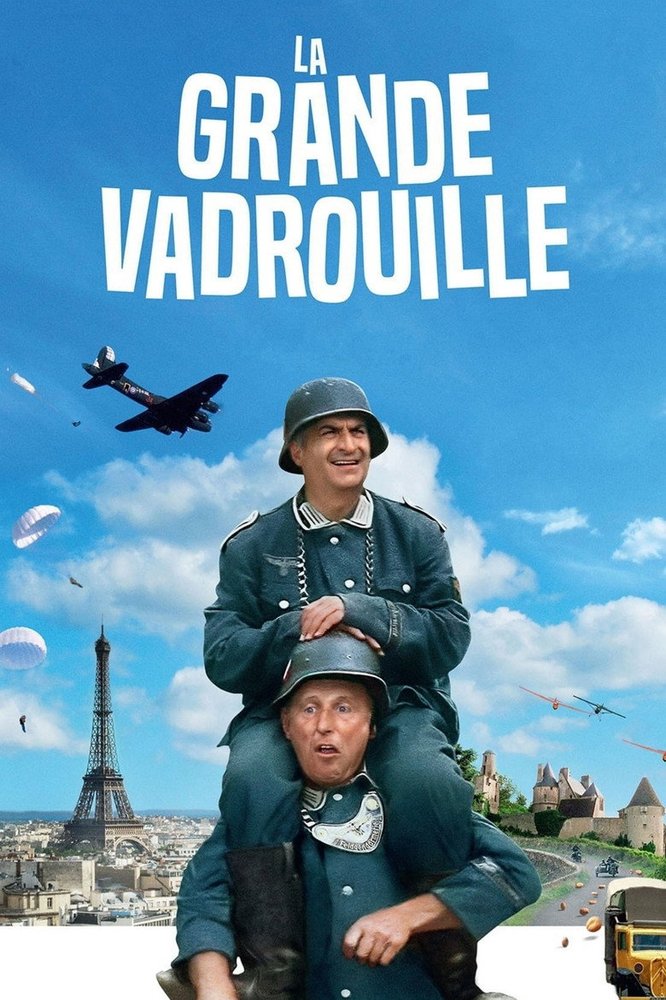
La Grande Vadrouille

Movie · 1966 · 15 people

Gérard Oury directed Şahane Oyun (original title La Grande Vadrouille), a French-British war comedy from 1966. In English-speaking countries it was shown as Don't Look Now... We're Being Shot At! As Oury's second comedy after Le Corniaud, it reunites that film's famous duo, Bourvil and Louis de Funès. It opened in France on December 8, 1966 and drew over 17 million viewers; it stayed the most-watched French film in France for over forty years until Bienvenue chez les Ch'tis overtook it in 2008. Turkey saw it in March 1970.

Set in Nazi-occupied Paris, the story begins when three crew members of a downed British bomber, Reginald, Peter Cunningham and Alan MacIntosh, parachute into the city. Two Frenchmen, opposites in temperament and class, help them: Bourvil's Augustin Bouvet, a naive house painter, and Louis de Funès's Stanislas LeFort, the irritable conductor of the Paris Opera. With the Germans on their tail, they try to reach unoccupied territory. Claudio Brook, Mike Marshall, Terry-Thomas and Marie Dubois are also in the cast.

It runs about 132 minutes, with English, French and German spoken. Oury wrote the screenplay with Danièle Thompson and Marcel Jullian. It still ranks third among the most-seen French films in France.

DirectorGérard Oury
Production companyLes Films Corona

Reactions

You can pick up to 3 reactions.

Cast

Only cast members with a profile on this site are listed.

Pierre Bertin Pierre Bertin Film actor · died at 92 Rémy Julienne Rémy Julienne Actor · died at 90 Bourvil Louis de Funès Terry-Thomas Helmuth Schneider Claudio Brook Mike Marshall Marie Dubois Mary Marquet Andréa Parisy Benno Sterzenbach Sieghardt Rupp Paul Préboist Henri Génès
Through different eyes

Family Viewer Asks whether the whole household can watch it; cares about humour and heart.

Don't Look Now... We're Being Shot At! is a comedy different generations can laugh at together. The war and the Nazi occupation are in the background, but the tone stays light throughout; the humour comes from chases and the sparring between two opposite characters. Young children may ask about the war, and a short explanation is enough. The film is on the long side, so very young ones may get restless. It is the kind of film grandparents will watch laughing too.

Cinephile Looks at script, editing and directing choices; keeps a distance from formula films.

Gérard Oury's film takes a formula already proven in Le Corniaud, the contrast between Bourvil and Louis de Funès, and carries it into a bigger production. Pairing a naive house painter with an irritable conductor turns differences of class and temperament into the engine of the comedy, and the structure works almost flawlessly. The script manages to tell a sensitive backdrop like occupied France at the tempo of a farce. If there is anything to criticise, it is the length: the escape journey repeats itself at some stops, and the pace sags now and then. Even so, it is no accident that it drew over 17 million viewers in France and held the record for decades.

History & Society Lens Asks about the period, the social background and what the work reflects.

Telling the story of Nazi-occupied Paris as a comedy was a bold choice only twenty years after the war. While treating the occupation in a light tone, the film brings different layers of French society, a house painter and the conductor of the Paris Opera, together in shared solidarity. That picture fits the story of united resistance that post-war France told itself; it serves more as national consolation than as historical reality. That the film has been so loved across generations in France also shows how much this optimistic narrative resonated socially.

These are not reader reviews: they are short editorial takes written from different viewer perspectives with AI assistance. Reader reviews are below.

Reviews (0)

Log in Log in to write a review.

Comments