Süper Jandarma ve Melekleri

The Gendarme and the Gendarmettes (Le Gendarme et les Gendarmettes)

Movie · 1982 · 15 people

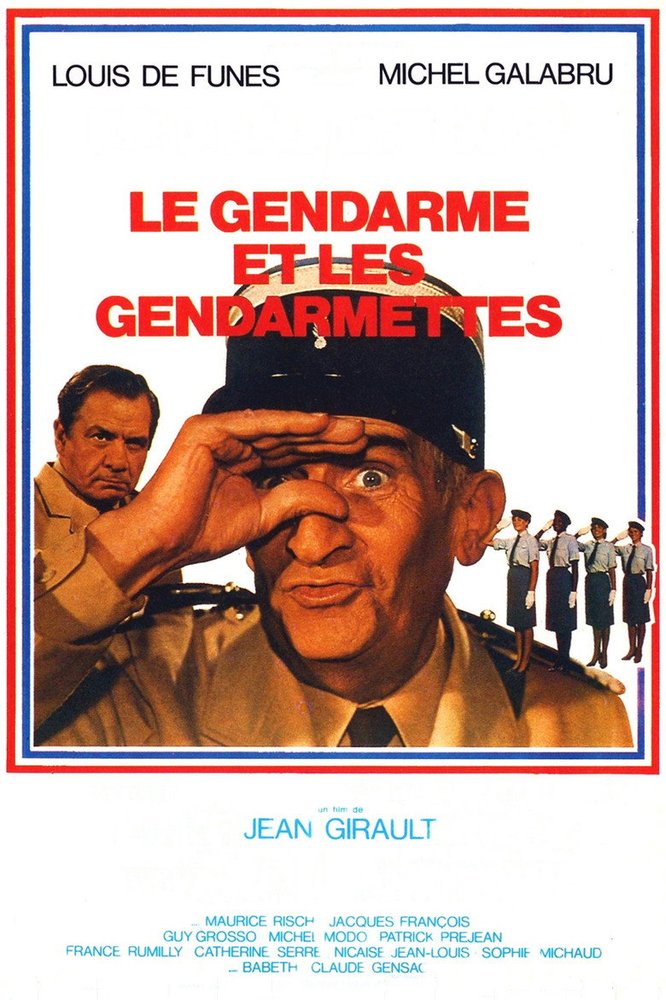
The Saint-Tropez gendarme series that began in 1964 ends with The Gendarme and the Gendarmettes (Le Gendarme et les Gendarmettes), a French comedy from 1982 and the sixth and last film. It is the last film of Louis de Funès and of director Jean Girault, both there since the first film. It opened in France on 6 October 1982.

Inspired by the first women entering the gendarmerie, the story has Ludovic Cruchot (Louis de Funès) and the Saint-Tropez brigade ordered to train four female auxiliaries imposed by the hierarchy, and to watch over them. The brigade includes Michel Galabru (as Gerber), Grosso and Modo, Maurice Risch and newcomer Patrick Préjean. Claude Gensac returns as Cruchot's wife Joséphine, and France Rumilly appears as a nun. The gendarmettes are played by Catherine Serre, Sophie Michaud, Nicaise Jean-Louis and Babeth.

Filming took place in and around Saint-Tropez and at the Boulogne studios, without the famous gendarmerie of earlier films. Girault died during shooting on 24 July 1982; his assistant Tony Aboyantz finished the film. Raymond Lefèvre composed the music. Reviews were disastrous, yet 4.2 million tickets were sold, the weakest result in the series. De Funès died in January 1983, ending the cycle.

DirectorJean Girault, Tony Aboyantz

Reactions

You can pick up to 3 reactions.

Cast

Only cast members with a profile on this site are listed.

Michel Galabru Michel Galabru Film actor · died at 93 Pierre Repp Pierre Repp Actor · died at 76 Louis de Funès Claude Gensac Maurice Risch Guy Grosso Michel Modo Patrick Préjean Catherine Serre France Rumilly Jacques François Babeth Étienne Bernard Pascual Franck-Olivier Bonnet Jean-Louis Richard

Through different eyes

Family Viewer Asks whether the whole household can watch it; cares about humour and heart.

The gendarme series is known as the kind of comedy young and old laugh at together, and this last film stays on the same family-friendly line. Louis de Funès's frantic, exaggerated style can make children laugh too. For grown-ups who have loved the series for years, it is a familiar reunion. But for children meeting the series for the first time, it is better to start with the early films rather than this last one.

Cinephile Looks at script, editing and directing choices; keeps a distance from formula films.

By the series' sixth film, the formula's fatigue is inevitably felt. Women gendarmes joining the brigade promises a fresh source of conflict, but the idea seems to offer a new excuse for familiar gags more than a new dynamic. Shooting without the series' famous gendarmerie also cuts an important thread tying the film's look to earlier entries. Director Jean Girault dying during the shoot, with his assistant Tony Aboyantz completing the film, is a plausible explanation for why it hangs together so loosely. So the harsh reviews are no surprise: the film is much weaker than the emotional value it carries as Louis de Funès's farewell.

History & Society Lens Asks about the period, the social background and what the work reflects.

The film's starting point rests on a real social change: the first women entering the gendarmerie. In that sense the comedy works as a small mirror of how early-1980s France greeted the change. Presenting the female auxiliaries as a burden imposed on the brigade from above reflects, through humour, the resistance in male-dominated workplaces of the time. Some of the jokes may look dated to today's audience, but that is exactly what makes the film an interesting document of how an era viewed gender roles. That it still sold over 4 million tickets suggests audiences then still embraced that outlook.

These are not reader reviews: they are short editorial takes written from different viewer perspectives with AI assistance. Reader reviews are below.

Reviews (0)

Log in Log in to write a review.

Comments