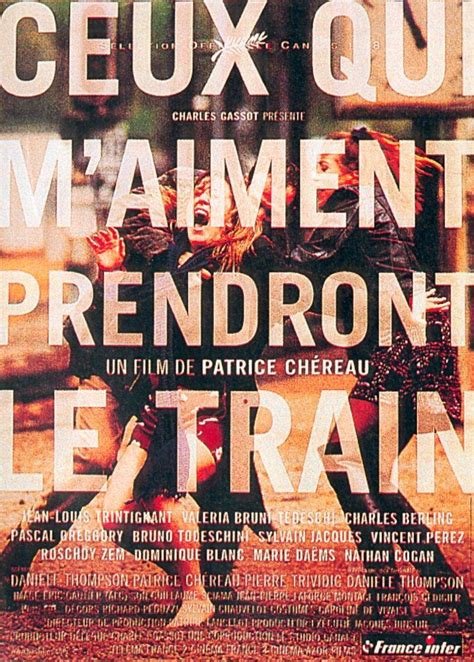
Those Who Love Me Can Take the Train

Those Who Love Me Can Take the Train (Ceux qui m'aiment prendront le train)

Movie · 1998 · 15 people

Patrice Chéreau directed the 1998 French drama Those Who Love Me Can Take the Train, titled Ceux qui m'aiment prendront le train in French. Running two hours, it picks apart a single day in the lives of about fifteen people in crisis who come together under the cover of a funeral. Chéreau wrote the screenplay with Danièle Thompson and Pierre Trividic, and the film competed for the Palme d'Or in the main competition of the 51st Cannes Film Festival.

The dead man is a painter, and former lovers, friends and rivals take the train to see him off. Over the journey and the ceremony, repressed feelings, jealousies and unsettled scores from the past come to the surface. The film stars Pascal Greggory, Vincent Perez, Charles Berling and Dominique Blanc, and the cast also includes Jean-Louis Trintignant, Valeria Bruni-Tedeschi, Bruno Todeschini, Guillaume Canet, Olivier Gourmet and Roschdy Zem.

At the 1999 César Awards the film received 11 nominations and won three: best director, best cinematography and best supporting actress. The soundtrack draws on Björk and Portishead as well as the music of Gustav Mahler.

DirectorPatrice Chéreau

Reactions

You can pick up to 3 reactions.

Cast

Only cast members with a profile on this site are listed.

Jean-Louis Trintignant Jean-Louis Trintignant Character Actor · died at 91 Vincent Perez Vincent Perez Film actor · 62 years old Pascal Greggory Valeria Bruni Tedeschi Charles Berling Bruno Todeschini Chantal Neuwirth Didier Brice Dominique Blanc Geneviève Brunet Guillaume Canet Marie Daëms Natan Cogan Olivier Gourmet Roschdy Zem
Through different eyes

Cinephile Looks at script, editing and directing choices; keeps a distance from formula films.

By squeezing a large cast into a single day and a single journey, Chéreau's film is almost a work of choreography. Each of its fifteen or so characters carries a crisis, and rather than separating and explaining them one by one, the film layers them on top of each other. The César wins for best director and best cinematography can be read as recognition of how hard it is to direct such a crowd in so little time and space. But the density has a steep price: telling the characters and their shared past apart takes effort, and two hours of tense encounters can be exhausting. The soundtrack, setting Björk and Portishead beside Mahler, suits the film's mixed, unruly spirit perfectly.

History & Society Lens Asks about the period, the social background and what the work reflects.

The film treats the funeral as a social ritual: a painter's death brings together, in one place, the web of former lovers, friends and rivals woven around him. That crowd resembles a family built on choice more than blood, and offers a cross-section of what an artist's circle looked like as a network of relationships at the end of the nineties. One of a ritual's real functions is to open a space where repressed feelings and old scores can surface, and the film puts that function at its centre. An interesting document for anyone curious about French cultural circles of the time and how such bonds are made and undone.

These are not reader reviews: they are short editorial takes written from different viewer perspectives with AI assistance. Reader reviews are below.

Reviews (0)

Log in Log in to write a review.

Comments