Death is serving

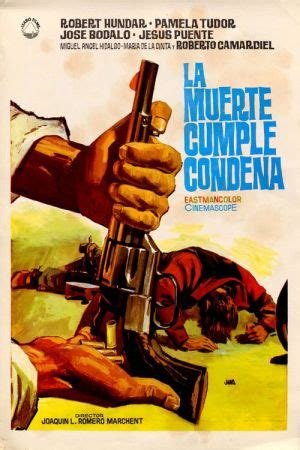
Death is serving (La muerte cumple condena)

Movie · 1966 · 14 people

From the early years of the spaghetti western boom comes La muerte cumple condena, known in English as Dollars for a Fast Gun, an Italian-Spanish western made in 1966. It was directed by Joaquín Luis Romero Marchent, with Mariano Canales as assistant director. Its Italian title is 100.000 dollari per Lassiter, its French title Cent mille dollars pour Lassiter and its German title 100.000 Dollar für einen Colt; in Germany it was also shown as Das letzte Wort hat der Colt. The film, in Spanish and Italian, runs about 99 minutes.

The screenplay is by Sergio Donati, the score by Marcello Giombini, and the producer was Alberto Grimaldi. Robert Hundar, Pamela Tudor, Roberto Camardiel and José Bódalo have the main roles, and the cast also includes Luigi Pistilli, Andrea Aureli, Giovanni Petrucci, Emilio Rodríguez, Lucio De Santis, Benito Stefanelli and Aldo Sambrell. Some sources describe it as a comedy western.

The picture is said to have marked the breakup between Marchent and Grimaldi, and colleagues of Sergio Leone contributed to it. It did not receive good reviews on release. Even so, Marchent westerns such as Seven Hours of Gunfire (1965), this film and I Do Not Forgive... I Kill! (1968) are counted among Quentin Tarantino's references.

DirectorJoaquín Luis Romero Marchent

Reactions

You can pick up to 3 reactions.

Cast

Only cast members with a profile on this site are listed.

Benito Stefanelli Actor · died at 71 Aldo Sambrell Aldo Sambrell Film actor · died at 79 Robert Hundar Luigi Pistilli Andrea Aureli Giovanni Petrucci Emilio Rodríguez Lucio De Santis José Bódalo Roberto Camardiel Fernando Bilbao Jesús Puente Luis Prendes Fernando Hilbeck

Through different eyes

Action & Thriller Fan Puts pace, tension and set pieces first; little patience for slow drama.

An early spaghetti western, and for a genre fan the real question is tone. Some sources call it a comedy western, which should count as a warning if you want hard, tense showdowns. Anyone after the cold tension of Leone's films may come away disappointed; if you are curious about the genre's earlier, lighter side, it is an interesting stop.

Cinephile Looks at script, editing and directing choices; keeps a distance from formula films.

Historically, the interest here lies less in the film than in the names around it: Sergio Donati on the script, Alberto Grimaldi producing, colleagues of Leone among the contributors. That a picture so close to the genre's founding team got poor reviews on release is a reminder that craft does not arrive automatically with the credits. Still, Marchent's westerns being counted among Tarantino's references is a solid reason for a second look. In my view it is best watched not as a lost masterpiece but as a sample from the years when the genre was still taking shape, and any verdict on Marchent as a director needs it set beside his other westerns, such as Seven Hours of Gunfire.

History & Society Lens Asks about the period, the social background and what the work reflects.

Being an Italian-Spanish co-production turns the film into a small but instructive document: the American Wild West myth, in the hands of two European film industries, becomes a story told in Spanish and Italian. To me the interesting part is European producers rebuilding that myth for their own audiences. The comic flavour some sources stress also suggests the myth is used here not as something sacred but as an entertainment template. A useful example for anyone trying to understand 1960s European popular cinema; expecting a deep social reading from it would be unfair.

These are not reader reviews: they are short editorial takes written from different viewer perspectives with AI assistance. Reader reviews are below.

Reviews (0)

Log in Log in to write a review.

Comments