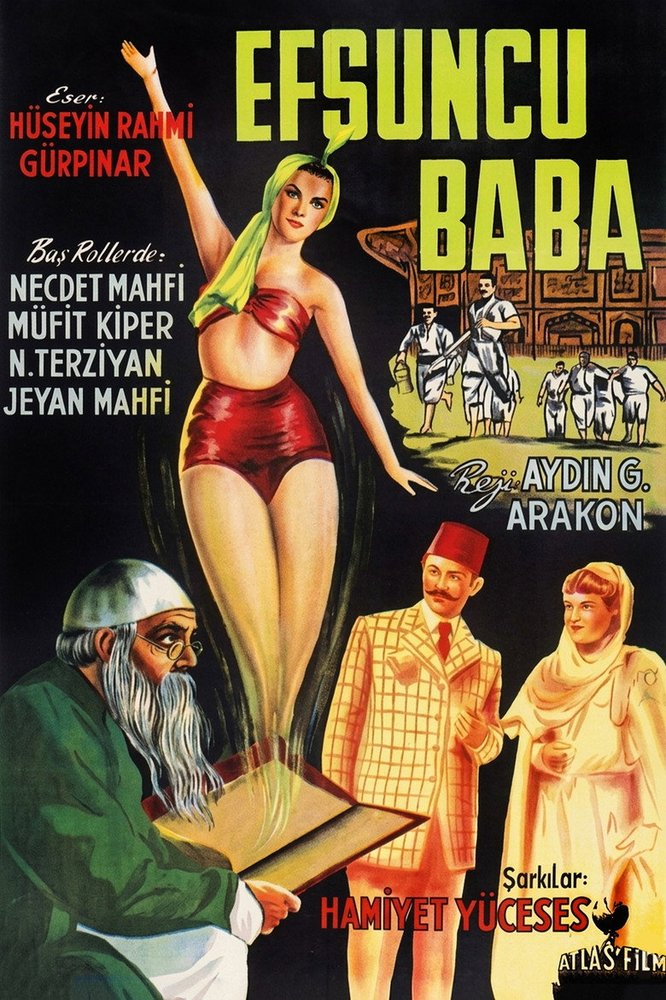
Efsuncu Baba

The Sorcerer Father (Efsuncu Baba) (translated)

Movie · 1949 · 3 people

Aydın Arakon wrote and directed Efsuncu Baba (also given as "The Magician"), a black-and-white Turkish film of 1949. It is adapted from a novel by Hüseyin Rahmi Gürpınar and mixes adventure, comedy and drama. Shot on 35 mm, it runs 85 minutes and opened on 19 April 1950. Nazif Duru produced it for Atlas Film, İlhan Arakon was cinematographer, the songs are by Hamiyet Yüceses and Nejat Duru was assistant director.

A treasure hunt lies at the centre. Ebülfazıl Enveri believes in the power of spells, talismans and amulets; convinced that the hidden treasure can be reached only this way, he gives his daughter Mevlüde to Nurullah Hasip. In this the film resembles Karagöz plays about sorcery and fortune-telling. Metin And cites Büyücü Hoca, Mal Çıkarma, Cincilik and Cambazlar as examples. In Cincilik, Hacivat comes to believe in Karagöz's magic and agrees to marry off his daughter; both Hacivat and Enveri act in their own interest.

Müfit Kiper plays Efsuncu Baba. The cast includes Necdet Mahfi Ayral (Agop), Nubar Terziyan (Kirkor), Dursun Şirin (Arap Bacı), Jeyan Mahfi Tözüm (the father's daughter) and Kemal Tanrıöver (the father's son-in-law).

DirectorAydın Arakon
Production companyAtlas Film

Reactions

You can pick up to 3 reactions.

Cast

Through different eyes

Yeşilçam Nostalgic A viewer raised on the classics, looking for warm storytelling and strong acting.

Adapted from a novel by Hüseyin Rahmi Gürpınar, Efsuncu Baba is a black-and-white treasure from the early years of Turkish cinema. Ebülfazıl Enveri, blindly trusting in spells, talismans and amulets, gives his daughter Mevlüde to Nurullah Hasip for the sake of a hidden treasure, and it recalls Gürpınar's sharp yet tender humour. Hamiyet Yüceses' songs give the film a flavour of its own; simply hearing the sound of those years is nostalgia in itself. Seeing veterans such as Nubar Terziyan and Necdet Mahfi Ayral in the same cast is a particular pleasure. It may feel slow to eyes used to today's pace, but it leaves the patient viewer with a warm taste of its era.

History & Society Lens Asks about the period, the social background and what the work reflects.

Efsuncu Baba puts belief in spells, talismans and amulets at its centre and uses humour to criticise a social weakness. Ebülfazıl Enveri, convinced the treasure can be reached only this way, gives his daughter to Nurullah Hasip, which also exposes an order in which daughters are married off according to a father's calculations. In this the film stands close to the Karagöz plays about sorcery and fortune-telling; in Cincilik, one of the examples Metin And cites, Hacivat likewise agrees to marry off his daughter, and both fathers act in their own interest. The 1949 film is a valuable example of where the comic tradition of the shadow play meets early Turkish cinema.

Family Viewer Asks whether the whole household can watch it; cares about humour and heart.

An old black-and-white Turkish film that mixes adventure, comedy and drama. It tells the story of a father who hunts for treasure and believes in magic. At a short 85 minutes, it can be a sweet bit of nostalgia for grandparents. Children may find the black-and-white picture and old-fashioned storytelling hard to get used to. A father marrying off his daughter for the sake of a treasure is questionable by today's standards, so it is worth talking that through with children while watching.

These are not reader reviews: they are short editorial takes written from different viewer perspectives with AI assistance. Reader reviews are below.

Reviews (0)

Log in Log in to write a review.

Comments