Flavia the Heretic

Flavia the Heretic (Flavia, la monaca musulmana)

Movie · 1974 · 12 people

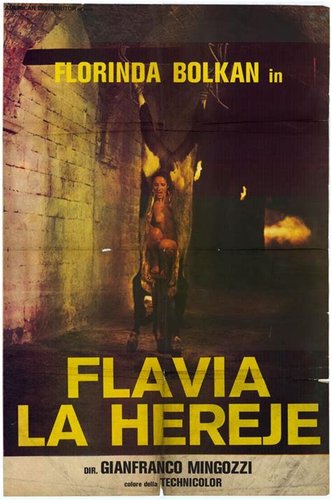
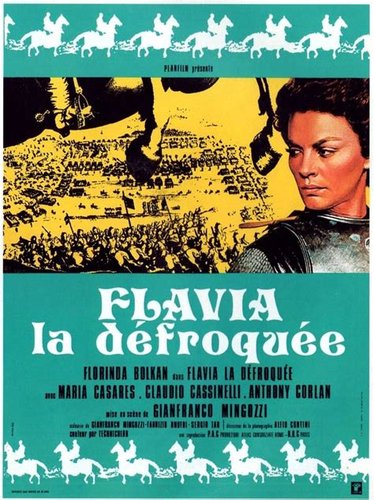
Flavia the Heretic, originally Flavia, la monaca musulmana ("Flavia, the Muslim nun"), is a 1974 Italian-French co-production directed by Gianfranco Mingozzi. It belongs to the controversial 1970s "nunsploitation" current, exploitation cinema that works convents and nuns through eroticism and violence, though it also carries elements of social criticism. The roughly 100-minute film was shot in Italian and released abroad under varying names: Castigata – Die Gezüchtigte and Die Nonne und der Freibeuter in Germany, Flavia la défroquée in France, La novicia musulmana in Spain.

The story unfolds in the Apulia region of southern Italy against events that recall the Ottoman campaign at Otranto. At its centre is Flavia, a young nun who refuses the role and the oppression imposed on her. She rebels against a patriarchal order, and her search for freedom and justice draws her towards the Islamic army. Her revolt soon turns into a spiral of violence. Florinda Bolkan stars, with María Casarès, Anthony Higgins, Claudio Cassinelli and Guido Celano in the cast.

Mingozzi wrote the screenplay with Raniero Di Giovanbattista, drawing on motifs from the Otranto campaign.

DirectorGianfranco Mingozzi
Flavia the Heretic (Flavia, la monaca musulmana) Flavia the Heretic (Flavia, la monaca musulmana)

Reactions

You can pick up to 3 reactions.

Cast

Only cast members with a profile on this site are listed.

Guido Celano Guido Celano Actor · died at 83 Maria Casarès Maria Casarès Actor · died at 74 Florinda Bolkan Claudio Cassinelli Spiros Focás Luigi Antonio Guerra Ciro Ippolito Anthony Higgins Laura De Marchi Diego Michelotti Carla Mancini Valentino Macchi
Through different eyes

Cinephile Looks at script, editing and directing choices; keeps a distance from formula films.

Flavia comes out of the nunsploitation current, which exploited convents through eroticism and violence, but Mingozzi's film carries an ambition to stand apart from the run-of-the-mill examples: it places a woman rebelling against a patriarchal order against a historical backdrop that recalls the Otranto campaign. The trouble is that this social critique tries to coexist with the genre's exploitative language. Beyond a certain point the violence risks ceasing to be a tool of critique and becoming the spectacle itself, and the film is forever trying to keep its balance on that line. For cinephiles curious about the history of the cycle it is worth studying; expecting a masterpiece in its own right would be unfair.

History & Society Lens Asks about the period, the social background and what the work reflects.

The historical backdrop is intriguing: southern Italy amid events recalling the Otranto campaign, and a nun who refuses the role forced on her. That Flavia's search for freedom draws her towards the Islamic army, the side her own society regards as the enemy, brings out the tension between religion, gender and belonging in a provocative way. But this setting is built not with a history film's care but with the overheated language of 1970s exploitation cinema. So the film says less about the era it depicts than about how debates on the church, women and freedom were put on screen in 1970s Europe.

Family Viewer Asks whether the whole household can watch it; cares about humour and heart.

This is not a family film. It comes from a cycle built on eroticism and violence, and violence is a major part of the story. It isn't something to watch with children or teenagers. Don't put it on for the family thinking it's a history film; it isn't the period drama you might expect. It's only for adults who choose this kind of cinema knowingly.

These are not reader reviews: they are short editorial takes written from different viewer perspectives with AI assistance. Reader reviews are below.

Reviews (0)

Log in Log in to write a review.

Comments