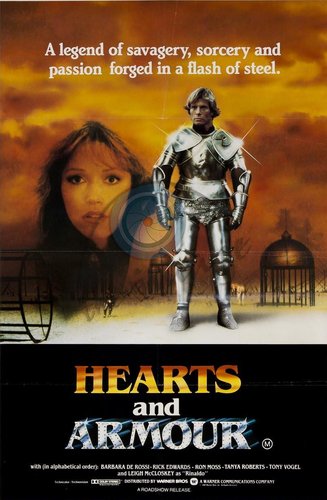
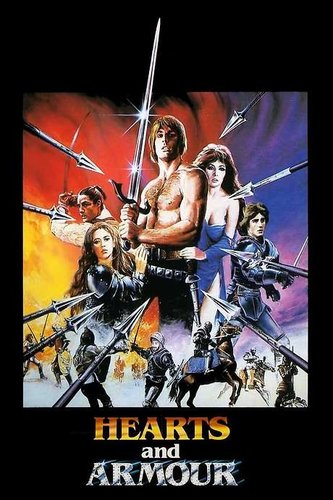
Hearts and Armour

Hearts and Armour (I paladini: storia d'armi e d'amori)

Movie · 1983 · 14 people

The tales of the paladins, above all Ludovico Ariosto's epic poem Orlando Furioso, loosely inspire Hearts and Armour (Italian: I Paladini: Storia d'armi e d'amori), which is also known under the alternative title Orlando furioso. Giacomo Battiato directed this 1983 Italian fantasy and adventure film, set in a medieval world, from a script he wrote with Luciano Vincenzoni and Sergio Donati; it runs about 100 minutes and was shot in English.

The cast includes Zeudi Araya, Barbara De Rossi, Tanya Roberts, Ronn Moss, Leigh McCloskey, Maurizio Nichetti, Lina Sastri, Giovanni Visentin, Haruhiko Yamanouchi, Ottaviano Dell'Acqua, Tony Vogel and Al Cliver.

Critics were generally harsh on the film when it came out, though they admired how it looked. The Sydney Morning Herald called the sets sensational and the costumes magnificent, while finding the story almost nonexistent. That visual side won it the David di Donatello for best costumes. It travelled under different names abroad: Le Choix des seigneurs in France and Duell der Besten in German-speaking countries, where it was first shown on November 11, 1983.

DirectorGiacomo Battiato
Hearts and Armour (I paladini: storia d'armi e d'amori) Hearts and Armour (I paladini: storia d'armi e d'amori)

Reactions

You can pick up to 3 reactions.

Cast

Only cast members with a profile on this site are listed.

Haruhiko Yamanouchi Haruhiko Yamanouchi Film actor · 80 years old Zeudi Araya Barbara De Rossi Ronn Moss Leigh McCloskey Maurizio Nichetti Giovanni Visentin Tanya Roberts Lina Sastri Massimo De Rossi Ottaviano Dell’Acqua Tony Vogel Al Cliver Bobby Rhodes

Through different eyes

Cinephile Looks at script, editing and directing choices; keeps a distance from formula films.

Hearts and Armour is close to a textbook case of how visuals alone cannot carry a narrative. The production and costume design are genuinely ambitious, and the David di Donatello for costumes is well earned. But squeezing Ariosto's sprawling, branching epic poem into a film of about a hundred minutes is a problem the script never solves. Many characters and plot strands sit side by side without real connection between them. It is no surprise critics found the story almost nonexistent. For anyone who wants to study the frame, it is an interesting document; for anyone who wants to follow a story, it is a tiring experiment.

Action & Thriller Fan Puts pace, tension and set pieces first; little patience for slow drama.

Knights, armour, a medieval adventure: on paper it is right up my street. But building tension is hard in a film where even the critics could not find the story. An adventure that never makes you feel something is at stake does not flow, however shiny it looks. Watch it for the spectacle if you like; if you want pace and thrills, keep your expectations low.

History & Society Lens Asks about the period, the social background and what the work reflects.

That one of Renaissance Italy's most famous epic poems became an English-language fantasy film in 1983 is an interesting cultural story in itself. Ariosto's world is built on court life, chivalry and love; the film turns that heritage into an adventure package meant for the international market. The way it travelled under different names in France and the German-speaking countries points the same way: it was conceived less as a literary adaptation than as an export product. In my view the film is more instructive about how early-eighties European cinema repackaged classic sources than about the poem itself.

These are not reader reviews: they are short editorial takes written from different viewer perspectives with AI assistance. Reader reviews are below.

Reviews (0)

Log in Log in to write a review.

Comments