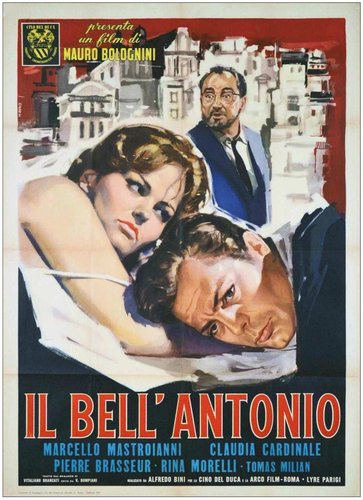
Il bell'Antonio

Il bell'Antonio

Movie · 1960 · 3 people

Marcello Mastroianni and Claudia Cardinale share the leads in Il bell'Antonio ("Handsome Antonio"), Mauro Bolognini's Italian-French drama of 1960, which reads as a wry, sharp look at masculinity, appearance and social expectation set against provincial Sicilian society. It won the Golden Leopard at the Locarno Film Festival, and in 2008 it entered the Italian Ministry of Cultural Heritage's list of 100 Italian films to be saved.

The film is based on Vitaliano Brancati's novel of the same name, published in 1949. Pier Paolo Pasolini and Gino Visentini wrote the screenplay together, moving the story from the fascist years to the present day of the shoot. Alongside Mastroianni and Cardinale come Pierre Brasseur, Rina Morelli and Tomas Milian, with Guido Celano, Fulvia Mammi, Cesarina Gheraldi, Jole Fierro and Anna Arena also in the cast.

The film is in Italian, runs 105 minutes and was made by Arco Film. The list it joined gathers productions made between 1942 and 1978 that are considered to have shaped the country's shared cinematic memory.

DirectorMauro Bolognini
Production companyArco Film

Reactions

You can pick up to 3 reactions.

Cast

Only cast members with a profile on this site are listed.
Through different eyes

Cinephile Looks at script, editing and directing choices; keeps a distance from formula films.

Bolognini, working from Pasolini and Visentini's script, moves Brancati's novel from the fascist years into the present day of the shoot, and that choice gives the film the edge of contemporary satire rather than the gravity of a period piece. Its wry look at masculinity, appearance and social expectation uses provincial Sicilian society as a clear backdrop. Mastroianni plays a figure weighed down by expectation without any excess, and Cardinale makes a lasting impression. The Golden Leopard at Locarno comes as no surprise. Still, the irony sometimes keeps us at arm's length from the characters; this is a somewhat cool film that asks for observation more than sympathy.

History & Society Lens Asks about the period, the social background and what the work reflects.

Brancati's novel was set in the fascist years; when Pasolini and Visentini's script moves the story to the days of the shoot, an interesting question arises: with the regime gone, how much had provincial ideas of manhood really changed? The film takes a wry, distanced look at how a man's worth in provincial Sicily is weighed by his appearance and by what society expects of him. For anyone wanting to read the tension between a fast-changing postwar Italy and traditional notions of family and reputation, it is a rich document. Its place, since 2008, on the list of 100 Italian films to be saved shows where it sits in the country's shared cinematic memory.

These are not reader reviews: they are short editorial takes written from different viewer perspectives with AI assistance. Reader reviews are below.

Reviews (0)

Log in Log in to write a review.

Comments