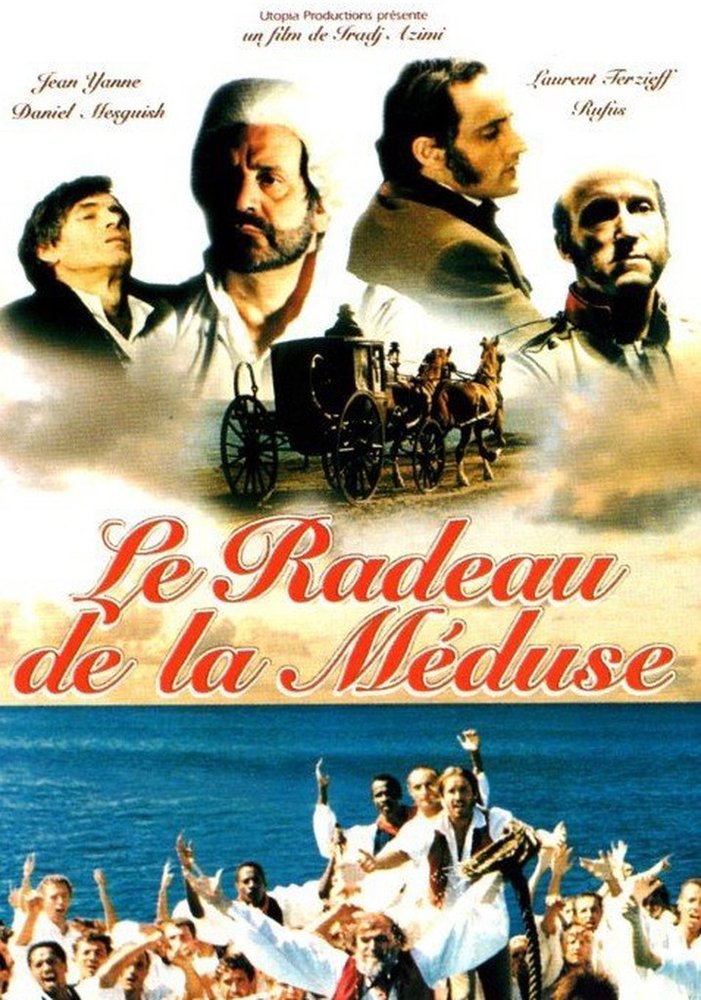
Le Radeau de la Méduse

Le Radeau de la Méduse

Movie · 1994 · 14 people

The true story of the French frigate Méduse, wrecked in 1816, and of how Théodore Géricault came to paint his celebrated 1819 canvas of the disaster is told in Le Radeau de la Méduse ("The Raft of the Medusa"). Iranian-born Iradj Azimi wrote and directed this French drama. The theatrical cut runs about 130 minutes, and the film took years to reach a wide audience in France.

The story runs on two tracks: the survivors' desperate struggle on a crude raft, and the painter's making of his masterpiece from the event. The cast is led by Jean Yanne, Daniel Mesguich, Claude Jade, Philippe Laudenbach, Rufus and Laurent Terzieff, with Jean Desailly and Alain Macé also credited.

Filming began in the Antilles in 1987. In September 1989 Hurricane Hugo wrecked the sets, the frigate among them, and they had to be rebuilt; the shoot ran until 1991 and was called a "hand-crafted super-production". The film was shown in a single art-house cinema in 1994 and reached French cinemas generally in 1998. While distribution stalled, Azimi cut his wrist in front of Ministry of Culture officials in protest. A three-part television version, 90 minutes each, was also made; it opens in 1815 with Napoleon (Jean-François Balmer) choosing exile.

DirectorIradj Azimi

Reactions

You can pick up to 3 reactions.

Cast

Only cast members with a profile on this site are listed.

Rufus Rufus Actor · 83 years old Daniel Mesguich Daniel Mesguich Stage actor · 74 years old Jean Yanne Claude Jade Laurent Terzieff Jean Desailly Philippe Laudenbach Alain Macé Jean Le Mouël Jérôme Anger Marie Matheron Michel Baumann Stéphanie Lanoux Victor Garrivier
Through different eyes

Cinephile Looks at script, editing and directing choices; keeps a distance from formula films.

Azimi's boldest idea is to run a disaster and the painting born from it as two tracks in one film. The structure is fertile ground for asking how art turns suffering into form: the desperate struggle on the raft and Géricault's studio are conceived as mirrors of each other. But the two tracks do not carry equal weight. The raft sections are physical and intense, while the painter's story stays more static, and the cuts between them sometimes break the rhythm. Given a production stretched over years after a hurricane wrecked the sets, reaching such a labour-intensive scale deserves respect. The result, though, is a long, uneven film that does not always live up to its ambition.

History & Society Lens Asks about the period, the social background and what the work reflects.

The wreck of the Méduse is a real event, and the film takes an interesting route to understanding how the disaster entered collective memory: by setting the event itself beside the painting that immortalised it. That raises the question of when, and through which image, a catastrophe takes on meaning in the public eye. The survivors' fight on the raft is a harsh observation of how people behave in extreme conditions, while the making of the painting shows how that experience was interpreted from outside. The film's own long struggle for distribution is, fittingly, a reminder of how hard it can be for a work to win public visibility.

Family Viewer Asks whether the whole household can watch it; cares about humour and heart.

The film follows the desperate struggle of shipwreck survivors left on a raft. The subject is heavy, and the survival scenes may be too harsh for young children. It is also long and slow. High-school-age teens with an interest in painting and history can watch it with an adult. It is not for anyone looking for family entertainment.

These are not reader reviews: they are short editorial takes written from different viewer perspectives with AI assistance. Reader reviews are below.

Reviews (0)

Log in Log in to write a review.

Comments