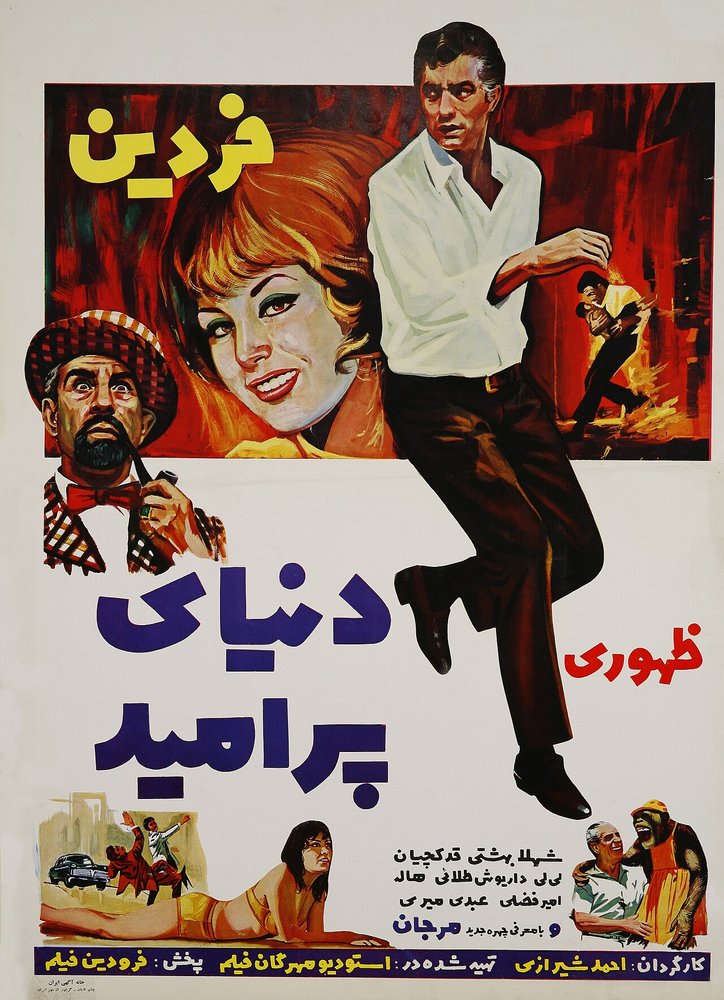
Marjan

Marjan

Movie · 1956 · 6 people

Shahla Riahi, a stage and screen actress who was also a known singer, became Iran's first female feature director with Marjan, a Persian-language Iranian drama from 1956. It was also the first feature in the history of Iranian cinema that a woman both directed and produced. Arya Film, the studio Riahi founded, made it as its first production, shooting in black and white on 35mm. Today it is counted among the rare, largely lost works of Iranian cinema, with only part of it surviving.

The story unfolds among a band of gypsies who settle near a village. Riahi herself plays Marjan, a young Roma woman, whose romance with Hamid, the village's young schoolteacher (Mohammad Ali Jafari), is set against the odds. Taghi Zohouri, Ahmad Qadakchian, Rahim Roshanian and Tajolmolouk Ahmadi also appear. The film launched Jafari's professional screen career, and Ahmadi was invited into dubbing work while making it.

The screenplay was the first writing credit of Manoochehr Keymaram, and Ahmad Shirazi was the cinematographer. Shooting began in mid-summer 1955 and lasted seven months, at a cost of roughly one million rials. Two reels have been preserved by a private collector, and the national film archive holds an incomplete print of about 45 minutes.

DirectorŞehla Riyahi
Production companyArya Film

Reactions

You can pick up to 3 reactions.

Cast

Only cast members with a profile on this site are listed.

Ahmad Qadakchian Actor · died at 86 Taghi Zohouri Taghi Zohouri Actor · died at 79 Mohammad-Ali Jafari Şehla Riyahi Mahvash Rahim Roshanian

Through different eyes

Cinephile Looks at script, editing and directing choices; keeps a distance from formula films.

Judging Marjan today is like reviewing a novel with pages torn out. The surviving fragments do not add up to a whole, and without knowing the rhythm of the editing, how the scenes connect or how the ending closes the structure, any firm verdict on the direction would be dishonest. Its real weight lies less in whether it is an aesthetic triumph than in how it was made: Riahi acting as director, producer, studio founder and lead at once amounts to a degree of creative control almost unheard of in its day. The impossible love between a Roma woman and a village teacher, meanwhile, is a familiar melodramatic mould; only a complete print could tell us how far the film breaks it.

History & Society Lens Asks about the period, the social background and what the work reflects.

There is a telling parallel between what the film shows and how it came to be. On screen, a line is drawn between the settled village and the nomadic camp, between those society accepts and those it keeps outside; behind the camera, a woman takes the director's chair that until then only men had occupied. The village schoolteacher feels like a deliberate choice too: a figure standing for education and modernisation forming a bond with an excluded community can, in my reading, be taken as a comment on the social questions of its time. That most of the film is now lost is a separate lesson in how fragile film heritage is.

Family Viewer Asks whether the whole household can watch it; cares about humour and heart.

This is not one to put on for the family after dinner. Only an incomplete print survives, so part of the story simply cannot be seen. Children will most likely lose the thread in the broken-up scenes. But for a teenager curious about film history, or grandparents who love old films, it is an interesting curiosity. Just explaining that it is the work of Iran's first woman director makes for a good conversation at home.

These are not reader reviews: they are short editorial takes written from different viewer perspectives with AI assistance. Reader reviews are below.

Reviews (0)

Log in Log in to write a review.

Comments