Paramparça

In the Fade (Aus dem Nichts)

Movie · 2017 · 3 people

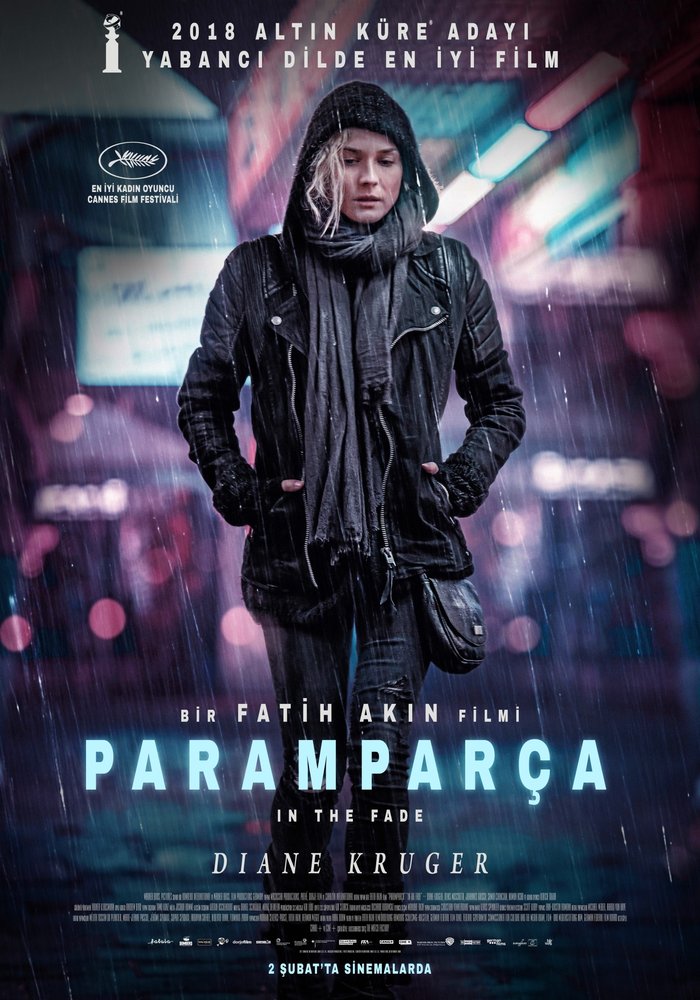
Fatih Akin wrote and directed In the Fade (German: Aus dem Nichts; Turkish: Paramparça), a 2017 German-French film, with Hark Bohm sharing the screenplay credit. Moving between melodrama, courtroom film and revenge thriller, it is also called neo-noir. It was inspired by the 2004 nail-bomb attack in Cologne carried out by the NSU. Shown in the Palme d'Or competition at Cannes on 26 May 2017, it won Diane Kruger the Best Actress award and later took the 2018 Golden Globe for Best Foreign Language Film.

Kruger plays Katja, who loses her husband Nuri, of Kurdish background, and their six-year-old son in a bombing. She wants to know who carried out the attack and why, and turns to the courts. The evidence points to far-right circles, but the court finds it insufficient and the suspects go unpunished. Furious at the verdict, Katja sets out to deliver justice herself. Denis Moschitto, Numan Acar, Ulrich Tukur and Johannes Krisch also appear.

Germany entered it for the 90th Academy Awards; it made the December shortlist of nine but was not nominated. The international title comes from a Queens of the Stone Age song, whose singer composed the score. The German title means "out of nowhere." The 106-minute film reached Turkish cinemas on 2 February 2018.

DirectorFatih Akın

Reactions

You can pick up to 3 reactions.

Cast

Only cast members with a profile on this site are listed.

Through different eyes

History & Society Lens Asks about the period, the social background and what the work reflects.

The film is inspired by the NSU's 2004 nail-bomb attack in Cologne, and that real background gives every scene its weight. The targeting of a man of Kurdish background and his family prompts reflection on far-right violence in Germany and on the insecurity felt by families shaped by migration. The courtroom section matters most: while the evidence points to far-right circles, the court finds it insufficient, raising a hard question about how the law can look from the victim's side. Fatih Akin chooses to tell this through a story of grief, turning an abstract debate into personal pain.

Cinephile Looks at script, editing and directing choices; keeps a distance from formula films.

Fatih Akin's film shifts between grief melodrama, courtroom drama and revenge thriller, and that structure is both its most interesting and its most fragile feature. The courtroom stretch is tightly written and moves with real tension. The revenge strand, by contrast, leans too heavily on genre conventions and somewhat flattens the subtle ambiguity of what came before. What carries the film is undoubtedly Diane Kruger. In the performance that won her Best Actress at Cannes she plays grief without exaggeration, as an almost physical exhaustion, filling the gaps the script leaves open. The 2018 Golden Globe shows how this bold but unevenly balanced work landed internationally.

Family Viewer Asks whether the whole household can watch it; cares about humour and heart.

This is not a film to watch with children. It follows a woman who loses her husband and six-year-old son in a bombing, and the grief, anger and urge for revenge are very intense. With older teenagers it can open a worthwhile conversation about racism and justice, but only from high-school age and with an adult in the room. A heavy evening's viewing, so be prepared.

These are not reader reviews: they are short editorial takes written from different viewer perspectives with AI assistance. Reader reviews are below.

Reviews (0)

Log in Log in to write a review.

Comments