The Cut

The Cut

Movie · 2014 · 8 people

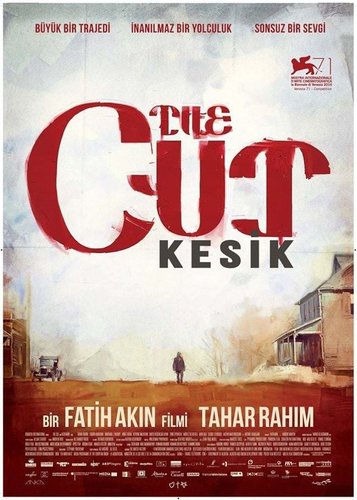
The Cut is a 2014 historical drama that follows the 1915 Armenian genocide and its repercussions through one man's eyes. Fatih Akın directed it and co-wrote it with Mardik Martin. It is the third and final part of Akın's "Love, Death and the Devil" trilogy, after Head-On (2004) and The Edge of Heaven (2007). It had its world premiere on August 31, 2014, in the main competition of the 71st Venice International Film Festival, where it contended for the Golden Lion; it opened in Germany on October 16, 2014, and in Turkey on December 5.

Nazaret Manoogian, a blacksmith in Mardin with a wife and twin daughters, sees his life change in one night: the region's Armenians are driven out and he is torn from his family. He survives, and over the years never stops searching for his children, a quest that carries him from Aleppo to Havana and on to North Dakota. Tahar Rahim stars, with Simon Abkarian, Arsinée Khanjian, Hindi Zahra, Kevork Malikyan, Makram Khoury and Trine Dyrholm; Moritz Bleibtreu and Numan Acar also appear.

Akın's logistically most demanding film to date, it is a Germany-France-Poland-led co-production. On the Turkish film site Beyazperde, Duygu Kocabaylıoğlu found the production strong but the script weak.

DirectorFatih Akın

Reactions

You can pick up to 3 reactions.

Cast

Names without a link have no profile here yet.

Also in the cast: Tahar Rahim (Nazaret Manoogian), Simon Abkarian (Krikor), Arsinée Khanjian (Frau Nakashian), Hindi Zahra (Rakel), Trine Dyrholm

Through different eyes

AI-assisted editorial takes written from different viewer perspectives. They are not reader reviews; those are below.

Cinephile Looks at script, editing and directing choices; keeps a distance from formula films.

The Cut is the most ambitious and logistically demanding part of Fatih Akın's Love, Death and the Devil trilogy. A route that runs from Mardin to Aleppo, Havana and North Dakota gives it an epic scale, and selection for Venice's main competition shows that ambition found recognition. Tahar Rahim carries the whole weight of the film on his shoulders. The script, however, breaks the continent-hopping search into episodes, and the more stops there are, the more the emotional intensity disperses. That Duygu Kocabaylıoğlu, writing in Beyazperde, found the script weak despite the strong production is understandable. Akın's ambition deserves respect, but anyone expecting the intensity of Head-On meets a wider, looser panorama here.

History & Society Lens Asks about the period, the social background and what the work reflects.

The Cut tells of the 1915 Armenian genocide, during the First World War, and its aftermath through the story of a blacksmith from Mardin. What makes the film notable is that it builds a great historical catastrophe not through figures or debates but through the years-long journey of a father searching for his twin daughters. The route from Aleppo to Havana and North Dakota also traces exile and scattered communities, a reminder that displacement is a rupture lasting generations. That English, Arabic and Turkish are all spoken reflects the many languages of the lands the story passes through. The film is focused less on a historical thesis than on the human condition.

Family Viewer Asks whether the whole household can watch it; cares about humor and heart.

The Cut tells of the Armenians being driven from their homes in 1915 and a father torn from his daughters. These heavy themes make it no film to put on casually with the family, and they are not suitable for the little ones. Its length also asks for patience. Watched with high-school-age teens who are interested in history and human stories, it can be a powerful starting point for a conversation afterwards.

Reviews (0)

Log in Log in to write a review.

Comments