Christine

Christine

Movie · 1958 · 15 people

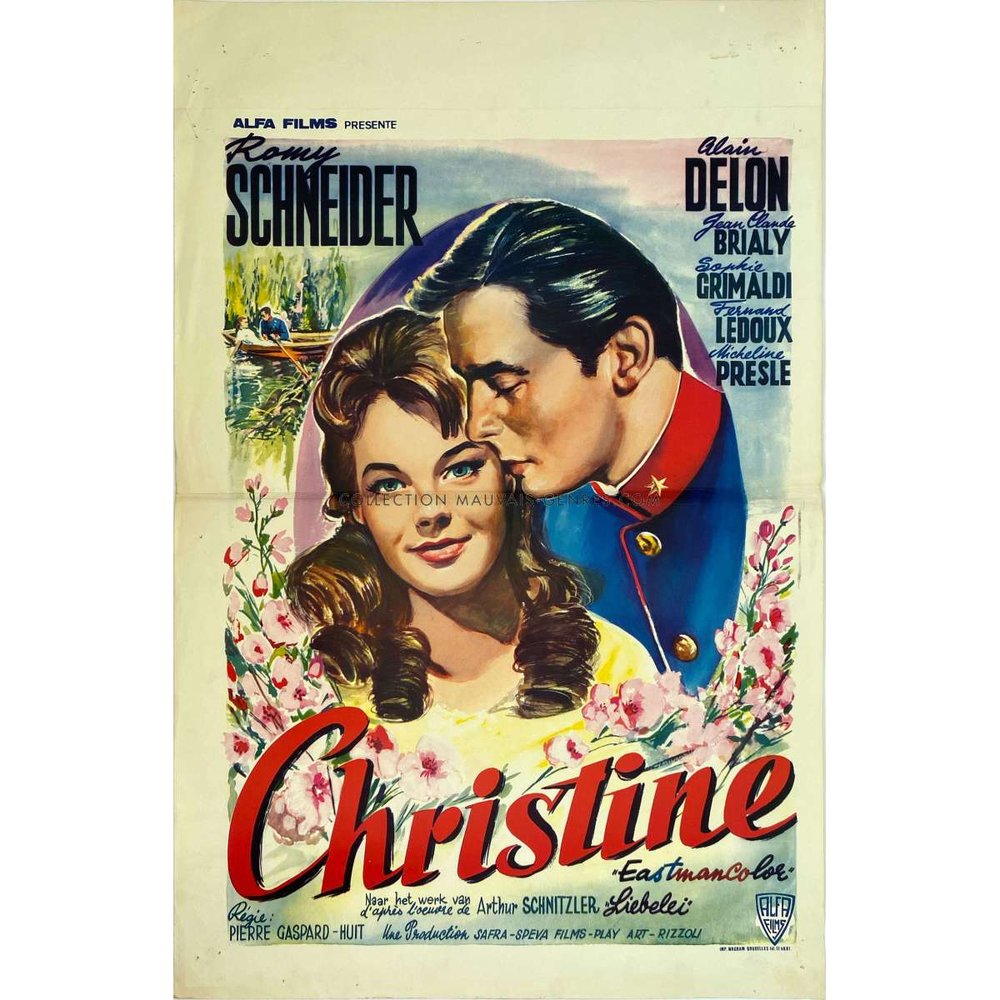
A period drama with a romantic story at its heart, the 1958 French-Italian melodrama Christine was directed by Pierre Gaspard-Huit. It is based on Arthur Schnitzler's play Liebelei and counts as a remake of the film Max Ophüls made from the same play in 1933. Shot in French and running about 100 minutes, it was first shown in Germany on 19 December 1958. Its Spanish title is Amoríos.

At the centre of the story is a young couple, Christine and a young lieutenant, whose shared happiness comes to a tragic end. Romy Schneider plays Christine and Alain Delon the lieutenant. The cast also features Micheline Presle, Jean-Claude Brialy, Jacques Toja, Fernand Ledoux, Joseph Egger, Allain Dhurtal, Bernard Dhéran, Claudine Auger, Dominique Zardi, François Chaumette, Jacques Duby, Jean Davy and Jean Galland. In the 1933 version, Christine had been played by Romy Schneider's mother, Magda Schneider.

The screenplay is by Hans Wilhelm, Pierre Gaspard-Huit and Georges Neveux, and filming took place at Boulogne-Billancourt near Paris. The picture is not counted among the major works in its stars' careers, but it is remembered because Schneider and Delon met on its set and went on to form one of the most emblematic couples of European cinema.

DirectorPierre Gaspard-Huit

Reactions

You can pick up to 3 reactions.

Cast

Only cast members with a profile on this site are listed.

Jean-Claude Brialy Jean-Claude Brialy Stage actor · died at 74 Dominique Zardi Actor · died at 79 Romy Schneider Alain Delon Micheline Presle Jacques Toja Fernand Ledoux Joseph Egger Allain Dhurtal Bernard Dhéran Claudine Auger François Chaumette Jacques Duby Jean Davy Jean Galland
Through different eyes

Cinephile Looks at script, editing and directing choices; keeps a distance from formula films.

With Max Ophüls's adaptation of the same play already on record, Christine's real test is to justify a remake. Pierre Gaspard-Huit doesn't answer that through form: the period sets, colour and costumes are handsome, but the camera settles for recording the story neatly rather than interpreting it. That is why the melodrama's tragic turn feels less like an emotional peak than a stop you saw coming. What keeps the film alive today is not the direction but the historical weight of Romy Schneider and Alain Delon sharing the screen. For anyone curious about where one of European cinema's famous couples began, it is a valuable document; as a work in its own right, it is a middling period piece.

History & Society Lens Asks about the period, the social background and what the work reflects.

Love between a young woman and a lieutenant is a favourite pattern of period drama; in such stories the uniform often brings a gap in status with it. The 1958 version, in my view, keeps the matter mostly within a romantic frame; rather than bringing any social layer forward, it chooses to give its audience a handsome couple and an inevitable sorrow. That choice makes it a typical product of the commercial European cinema of its day. The link across generations is another point of interest: Magda Schneider, Romy's mother, had played the same part in the 1933 version, so the role passes down almost like a family inheritance.

Family Viewer Asks whether the whole household can watch it; cares about humour and heart.

A romantic but sad period film. A young couple's happiness ends tragically, so anyone expecting a light love story may be caught off guard. The pace is calm and the style old-fashioned; young children are very likely to get bored. It suits adults and grandparents who enjoy melodrama as an evening film. If teenagers are watching too, it's worth warning them up front that the ending is heavy.

These are not reader reviews: they are short editorial takes written from different viewer perspectives with AI assistance. Reader reviews are below.

Reviews (0)

Log in Log in to write a review.

Comments