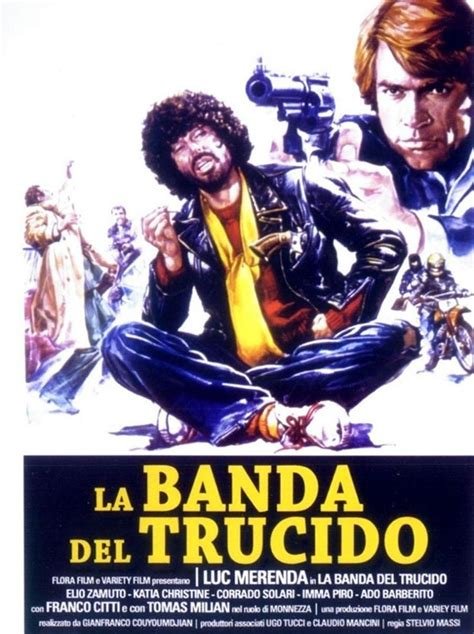
Destruction Force

Destruction Force (La banda del trucido)

Movie · 1977 · 15 people

Destruction Force, titled La banda del trucido in Italian, is a 1977 Italian poliziottesco directed by Stelvio Massi, blending crime and comedy over roughly 99 minutes. It is also known as Dirty Gang, and was released in France as L'exécuteur vous salue bien and in Germany as Die Gangster-Akademie. Elisa Briganti, Dardano Sacchetti and Massi wrote the script.

The film is the fourth entry in the shared universe of the characters Tanzi, Moretto and Monnezza. It is the second film in which Tomas Milian plays Monnezza, and a direct sequel to Il trucido e lo sbirro (Free Hand for a Tough Cop). Alongside Milian, the cast features Luc Merenda, Nello Pazzafini, Massimo Vanni, Franco Citti, Mario Brega and Imma Piro.

Milian took part because of an old contract he had to fulfil. Monnezza was first planned as a guest part and was enlarged so that the actor would seem the film's star; in return, Milian got to shape the character as he wished and to write his own lines, uncredited. The film was shot in three weeks, but Milian filmed his part in just five days. In German cinemas it opened on 8 March 1985 in a version cut by several minutes; the uncut edition came only in 2010 on DVD and 2021 on Blu-ray.

DirectorStelvio Massi

Reactions

You can pick up to 3 reactions.

Cast

Only cast members with a profile on this site are listed.

Luc Merenda Luc Merenda Actor · 83 years old Nello Pazzafini Nello Pazzafini Actor · died at 62 Tomás Milián Massimo Vanni Elio Zamuto Franco Citti Mario Brega Imma Piro Katia Christine Benito Pacifico Salvatore Billa Roberto Dell'Acqua Francesco D'Adda Aldo Barberito Fortunato Arena
Through different eyes

Action & Thriller Fan Puts pace, tension and set pieces first; little patience for slow drama.

If you want a poliziottesco that mixes cops and comedy, this one keeps that vein going, with a catch: Milian, who carries the film as Monnezza, shot his scenes in five days, and in my view it shows. The stretches with him have real energy; the rest struggles to hold the pace. Newcomers to the series will get far more out of the characters if they watch the previous film first.

Cinephile Looks at script, editing and directing choices; keeps a distance from formula films.

The most interesting thing about the film is the deal behind it: Monnezza, conceived as a guest part, was enlarged to make Milian look like the star, and the actor wrote his own lines. That bargain has seeped into the structure. The script swings between two centres of gravity, and the crime plot and Milian's self-penned comedy do not always feel like parts of the same film. Being the fourth link in a shared universe lets it wink at viewers who know the characters, but anyone coming to it alone gets a world that feels half-finished. The haste of a three-week shoot shows in the choppy editing. A worthwhile archive piece for genre fans, but too scattered for anyone after a tidy narrative.

History & Society Lens Asks about the period, the social background and what the work reflects.

This film's history offers a small clue to how 1970s Italian genre cinema was regarded. It was shot quickly so an actor could work off an old contract, reached Germany only years later and in a cut version, and its uncut form surfaced on home video much later still. In other words, it was long treated as a disposable product rather than something to take seriously. The fact that such films are now reissued in full shows how far attitudes to popular cinema have shifted. Its choice to blend crime with comedy also suggests how routine crime stories had become as everyday entertainment in those years.

These are not reader reviews: they are short editorial takes written from different viewer perspectives with AI assistance. Reader reviews are below.

Reviews (0)

Log in Log in to write a review.

Comments