Jamón, jamón

Jamón Jamón

Movie · 1992 · 7 people

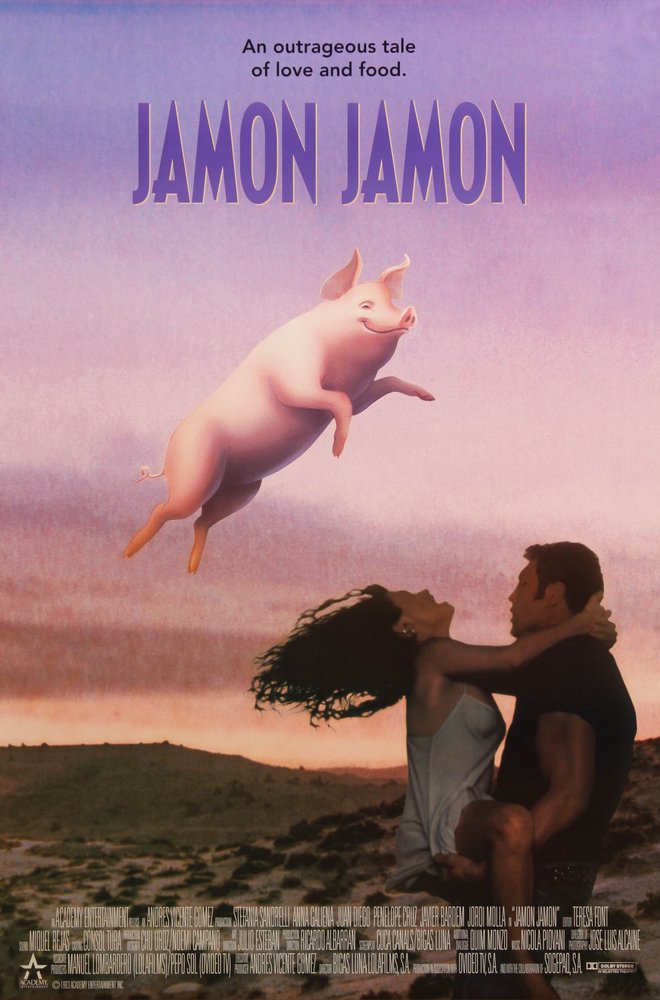
Bigas Luna directed the 1992 Spanish-Italian romantic tragicomedy Jamón, jamón (Ham, Ham in English). It is known as Penélope Cruz's debut, made at 18. It drew largely favorable reviews and won Luna the Silver Lion at the 1992 Venice Film Festival. It is the first film of Luna's Iberian Trilogy, with Golden Balls and The Tit and the Moon to follow.

The story is set in post-Franco Spain, in a small town. Jose Luis (Jordi Mollà), heir to an underwear factory, falls for Silvia (Cruz), a young worker there, and she becomes pregnant. His mother Conchita (Stefania Sandrelli) will not accept the match and sets out to pull Silvia away from her son by bringing a handsome man, Raul (Javier Bardem), into her life. Filming took place in the barren Monegros region of Aragon. Anna Galiena and Juan Diego also appear.

The film is read as an allegory of Spain: old and new side by side, wordplay, and contrasts between erotic desire and food. Symbols of traditional cuisine, such as ham, tortilla and garlic, run through it, along with the bull as a figure of virility. Luna, Cuca Canals and Quim Monzó wrote the script, and the producers were Lolafilms, Ovídeo TV and Sogepaq.

DirectorBigas Luna
Production companyLolafilms, Ovídeo TV, Sogepaq

Reactions

You can pick up to 3 reactions.

Cast

Only cast members with a profile on this site are listed.

Stefania Sandrelli Stefania Sandrelli Actor · 80 years old Juan Diego Juan Diego Film actor · died at 79 Anna Galiena Penélope Cruz Javier Bardem Jordi Mollà Miquel García Borda

Through different eyes

Cinephile Looks at script, editing and directing choices; keeps a distance from formula films.

In Jamón, jamón Bigas Luna builds not a realistic love drama but a deliberately exaggerated theatre of symbols. Images such as ham, garlic, tortilla and the bull are packed into the story so densely that the characters at times become allegorical figures. It is a bold choice, and the Silver Lion in Venice rewarded it; but that same density is also the film's weak spot, because the symbols sometimes stand in front of the emotion instead of carrying it. The arid Monegros landscape is an apt choice of setting that visually supports the tension between desire and barrenness. The tragicomic tone is not one everyone will catch easily either; miss the irony and the film can seem simply crude.

History & Society Lens Asks about the period, the social background and what the work reflects.

The film lends itself well to reading post-Franco Spain's transition through a family drama in a small town. The relationship between the heir to an underwear factory and a young woman who works there puts class difference at the very heart of the story, while the mother who rejects her son's choice stands for the resistance of traditional family authority. In a world where old and new stand side by side, the symbols of food and virility work as an ironic comment on national identity. For anyone curious about Spain's changing society, it is an allegorical but sharp portrait of its time.

Family Viewer Asks whether the whole household can watch it; cares about humour and heart.

Not one for family viewing. The film puts erotic desire squarely at its centre and its story is adult: a pregnancy and a mother scheming to pull her son away from the girl he loves. Do not watch it with children or teenagers. Adults curious about European cinema may find it interesting, but some will find its frankness uncomfortable.

These are not reader reviews: they are short editorial takes written from different viewer perspectives with AI assistance. Reader reviews are below.

Reviews (0)

Log in Log in to write a review.

Comments